
  
Analysis South Korea moves to curb ‘free labor’ under comprehensive wage systemGuidelines enforce existing law through audits while pending bills aim to ban misuse and mandate precise hour tracking  The labor ministry earlier this month announced guidelines to eradicate so-called “free labor” linked to comprehensive wage contracts, following targeted on-site inspections of 100 youth-heavy workplaces in the IT and service sectors since February. The announcement was followed by a two-month inspection starting Tuesday, based on anonymous tips from workers, targeting 300 workplaces in the first half of 2026. The crackdown was catalyzed by the London Bagel Museum scandal, in which employees used social media to expose 15-hour workdays without overtime pay after a staff member reportedly died of overwork. The company justified the lack of additional compensation by arguing that overtime was already included in monthly salaries, triggering national outrage over how comprehensive wage arrangements can be used in practice. While an amendment to the Labor Standards Act remains pending in the National Assembly, Labor Minister Kim Young-hoon has asserted that existing law already requires fair compensation based on actual hours recorded in wage ledgers. By moving ahead through administrative guidance rather than waiting for legislation, the government is pushing immediate changes in transparency and compliance for businesses and workers alike. This Korea Pro analysis examines what the comprehensive wage contract (포괄임금계약) is, what the new guidelines will change on the ground and what to expect from the pending bills in the National Assembly.  Labor ministry’s posters promoting anonymous tip-off of employers misusing the comprehensive wage system, April 9, 2026 | Images: ROK Ministry of Employment and Labor WHAT IS THE COMPREHENSIVE WAGE SYSTEM? The comprehensive wage system is not explicitly defined in the Labor Standards Act. Instead, it is a doctrine recognized only exceptionally by the ROK Supreme Court for specific duties where calculating working hours is challenging. The labor ministry’s guidelines define it as a method of wage calculation in which wages are predetermined regardless of actual working hours, with base pay and various allowances paid together in a lump sum without distinction. Originally, it was intended for cases in which it is difficult to accurately measure clock-in and clock-out times, such as surveillance, intermittent or field-based roles. However, the ministry argues that the practice has spread well beyond those narrow circumstances into office and IT positions where working-hour management is entirely possible. There are two main types of comprehensive wage methods commonly used in South Korea, and the ministry’s guidelines explicitly classify both as targets for prohibition.
Companies have favored comprehensive wage arrangements because they reduce the administrative burden of calculating fluctuating monthly overtime pay and allow labor costs to be managed as predictable fixed expenses. This is especially relevant for foreign companies, whose global HR systems often struggle to reflect South Korea’s complex allowance structure, including stacked premiums for overtime (50%), overnight work (50%) and holiday labor (50% to 100%). But under such arrangements, employees who regularly work overtime may be systematically underpaid for their actual hours. The ministry now defines this as an unfair practice, asserting that a signed agreement cannot be used to bypass mandatory compensation. The ROK Supreme Court has already placed strict limits on the valid scope of comprehensive wage contracts. Rulings such as 2008다57852 (2009) and 2008다6052 (2010), both directly cited in the guidelines, establish that such agreements are invalid if they disadvantage the worker.  Labor Minister Kim Young-hoon inspecting illegal subcontracting at construction sites, Sept. 18, 2025 | Image: ROK Ministry of Employment and Labor WHAT CHANGED NOW? The ministry’s guidelines state that if contracted wages fall short of the statutory allowances calculated under existing legal standards, the difference must be paid. In effect, the guidelines interpret comprehensive wage arrangements not as final settlements, but as baseline payments subject to reconciliation. At the same time, the ministry has launched a “Basic Labor Order Inspections” system and an anonymous reporting center, under which flagged companies are prioritized for immediate inspection or for inclusion in the year-end audit pool. The ministry has warned of fines and criminal prosecution for violators. By invoking Article 48 (Wage Ledgers) and Article 56 (Statutory Allowances) of the Labor Standards Act, the ministry now treats the failure to “record” working hours or the maintenance of inadequate wage ledgers, as a direct legal violation even where such omissions have previously been excused through comprehensive wage agreements. The guidelines impose three main documentation and compliance principles.
Since February, 774 workplaces have been reported through the anonymous tip system, with “wage theft” comprising roughly 80% of complaints, including non-payment on designated paydays (64.5%) and unpaid overtime, leave and holiday allowances (15.5%), the ministry said Tuesday. 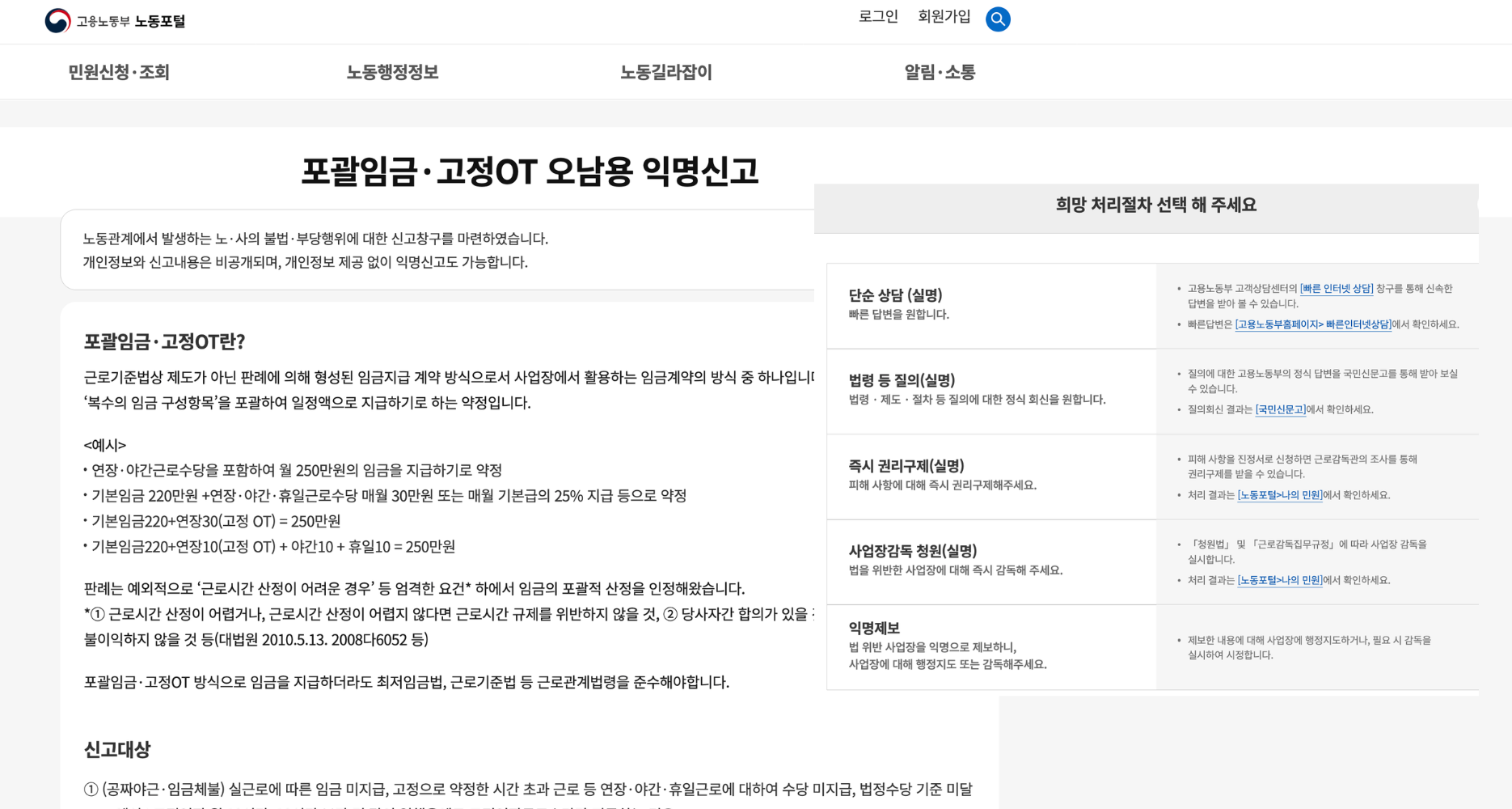 The labor ministry website on anonymous complaints related to comprehensive wage and “fixed overtime” payment, April 21, 2026 | Image: MOEL Screenshot WHAT THE BILL WOULD ADD While the current guidelines rely on existing law, pending amendments that are likely to pass this year would go further. The bill proposed by ruling Democratic Party lawmaker Kim Ju-young is likely to become the main legislative vehicle among those currently tabled. The ministry cited it in the guidelines, and it emerged from high-level consensus-building among labor, management and government experts through the Working Hour Reduction Roadmap Task Force (노사정위원회). The bill would first move wage-ledger (임금대장) requirements from the Enforcement Decree into the Labor Standards Act itself, requiring employers to record overtime, night and holiday hours by workday rather than in monthly totals. Second, it would create a new Article 48-3 granting employees the legal right to inspect and request corrections to wage records. Employers would no longer be able to refuse access to ledgers or related evidence without justifiable reason. This would shift labor records from being controlled almost exclusively by employers to being something workers can actively challenge. Third, the bill would create a new Article 56-2 to “prohibit” comprehensive wage agreements in principle. It would explicitly require that statutory premiums correspond to actual hours recorded in the wage ledger and that any shortfall between fixed pay and actual hours worked be compensated by the employer. The current version of the bill would apply immediately from the first pay cycle following enforcement. More aggressive proposals in the National Assembly go further still, including punitive damages for non-compliance and measures that would shift the burden of proof, so that employee claims are presumed true where records are inadequate. 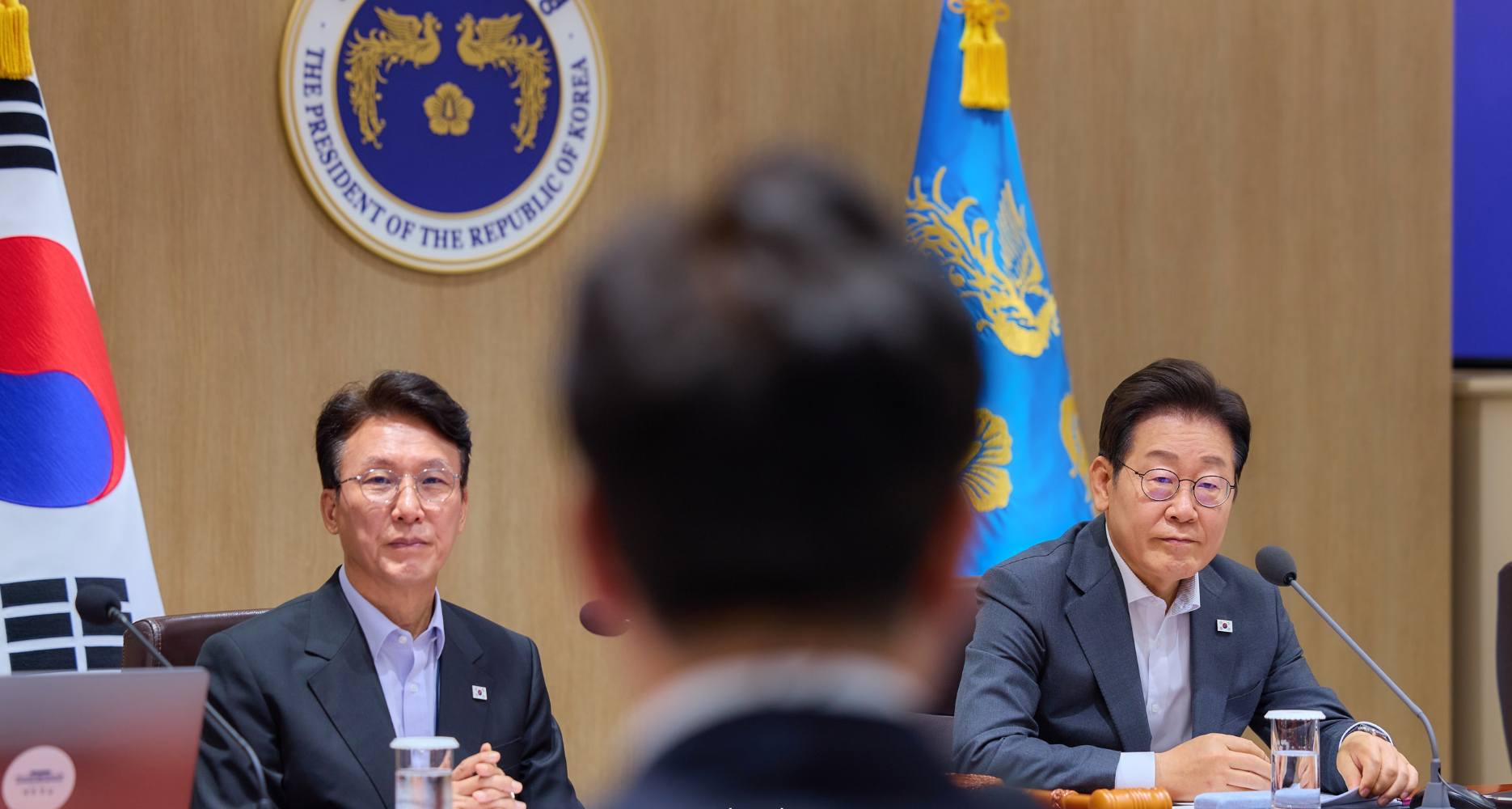 South Korean President Lee Jae Myung and Prime Minister Kim Min-seok listen to Labor Minister Kim Young-hoon’s remarks during a cabinet meeting, July 22, 2025 | Image: Blue House via Twitter THE BROADER SHIFT These regulatory changes sit within a broader shift under the Lee Jae Myung administration, in which public anger over high-profile labor abuses is being used to justify faster movement on a progressive agenda. The CEO of the London Bagel Museum ultimately stepped down and the labor ministry fined the company around $540,000 (801 million won), and ordered over $380,000 (564 million won) in unpaid wages after investigating the death of the young worker who allegedly died of overwork. Since Lee’s inauguration last year, it has become increasingly common for administrative notices and enforcement instructions to operationalize election pledges ahead of formal legal change in the National Assembly. This pattern can also be seen in areas such as the Financial Services Commission’s preemptive adjustment of loan-to-value ratios and the Fair Trade Commission’s revised enforcement rules for digital platforms. What these moves share is a legal and regulatory preference for substantive reality over formal arrangements. Just as the Yellow Envelope Act looks past contracts to identify the real, “de facto” employer, the comprehensive wage guidelines place the burden on employers to track and compensate actual hours worked rather than the literal text of a pre-existing contract. In addition, the expanded the definition of an employer to include those who “substantially and specifically” determine labor conditions, even without a direct contract — the core of the Yellow Envelope Act — directly relates to the comprehensive wage now as well. If a prime contractor’s contract pricing effectively forces a subcontractor into a comprehensive wage violation, the prime contractor can now be forced to the bargaining table, depending on how the subcontractor’s union frames it. While the Yellow Envelope Act focuses on the duty to bargain rather than the direct duty to pay wages, these two reforms create synergy against the employer, pressuring it to bargain. 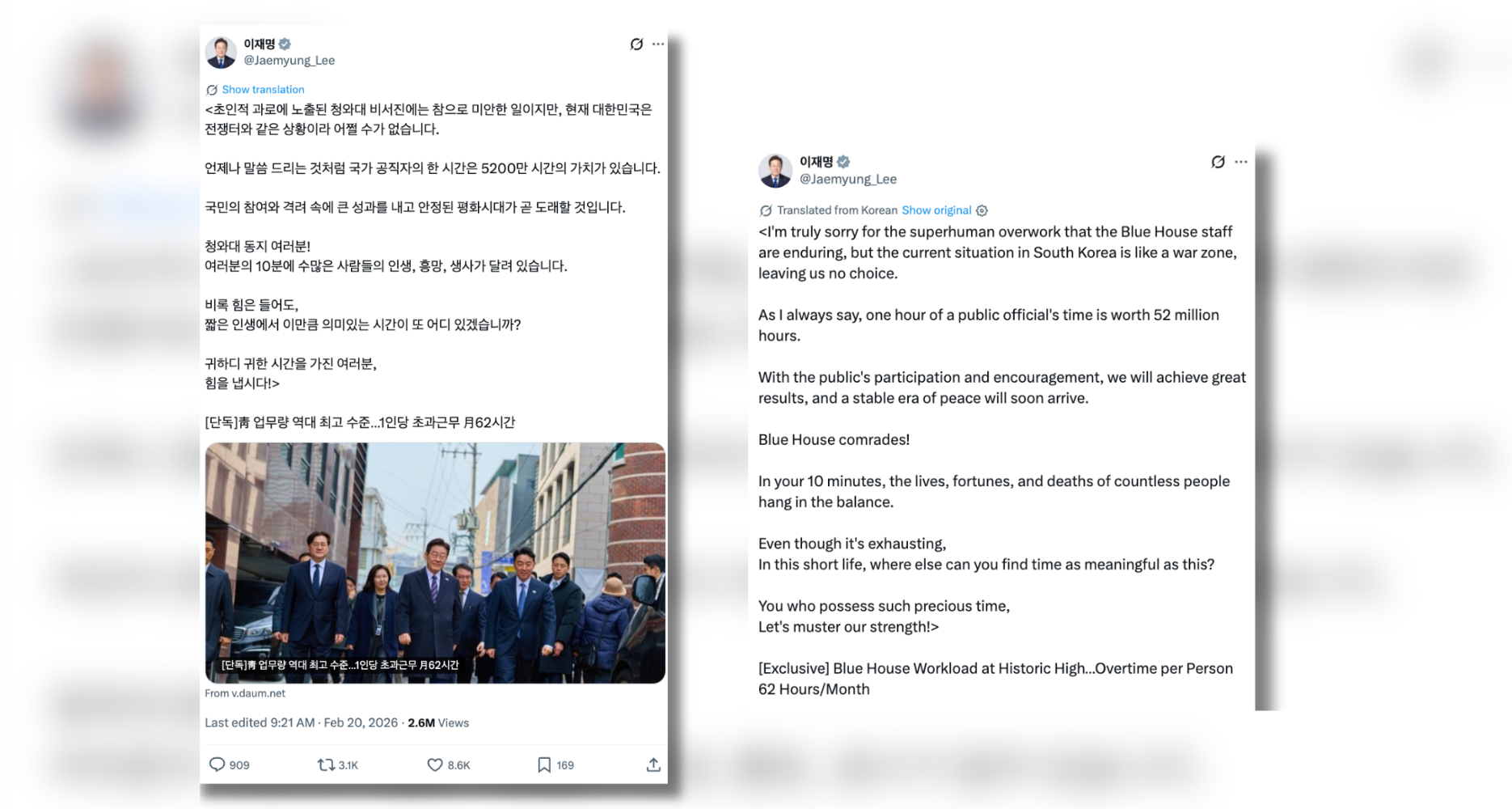 President Lee Jae Myung’s social media post on Feb. 20, 2026 about the ‘record-high’ level of his Blue House staff overwork, Feb. 20, 2026 | Images: Lee Jae Myung via Twitter WHAT TO DO International bodies such as the International Labor Organization have long criticized South Korea’s long working hours and opaque pay practices. The proposed amendments, together with the ministry’s emphasis on hour tracking, would move South Korea closer to internationally preferred standards such as ILO Convention No. 1 (1919) on Hours of Work (Industry) and No. 30 (1930) on Hours of Work (Commerce and Offices). For businesses, this means daily hour-by-hour labor records are no longer a secondary administrative issue. They are now central to labor compliance, internal control and, increasingly, supply-chain governance. A wait-and-see approach is also becoming harder to defend. Even before the National Assembly finishes legislating, the ministry’s guidelines are already shaping the new operational baseline. To mitigate immediate risk, companies must review their time-management infrastructure, and consider implementing digital or biometric clock-in systems as legal safeguard regarding the new mandatory recording duties that’s pending legislation. Management is advised to also conduct an exhaustive audit of all existing comprehensive wage contracts, as any fixed allowance that risks being judged by the ministry to have failed to cover actual overtime must be adjusted to include a clear reconciliation mechanism. For foreign enterprises in particular, South Korea’s premium-stacking rules for overtime, night work and holidays are likely to become a growing point of friction with centralized global HR platforms that were not designed for such distinctions. The more closely inspectors scrutinize actual hours against recorded compensation, the harder it will be to defend systems that flatten or obscure those categories. Edited by John Lee © Korea Risk Group. All rights reserved. 
|

September 17, 2026Sep 17, 2026

Never be sidelined again
 SHARE
SHARE COPY LINK
 X
X MASTODON