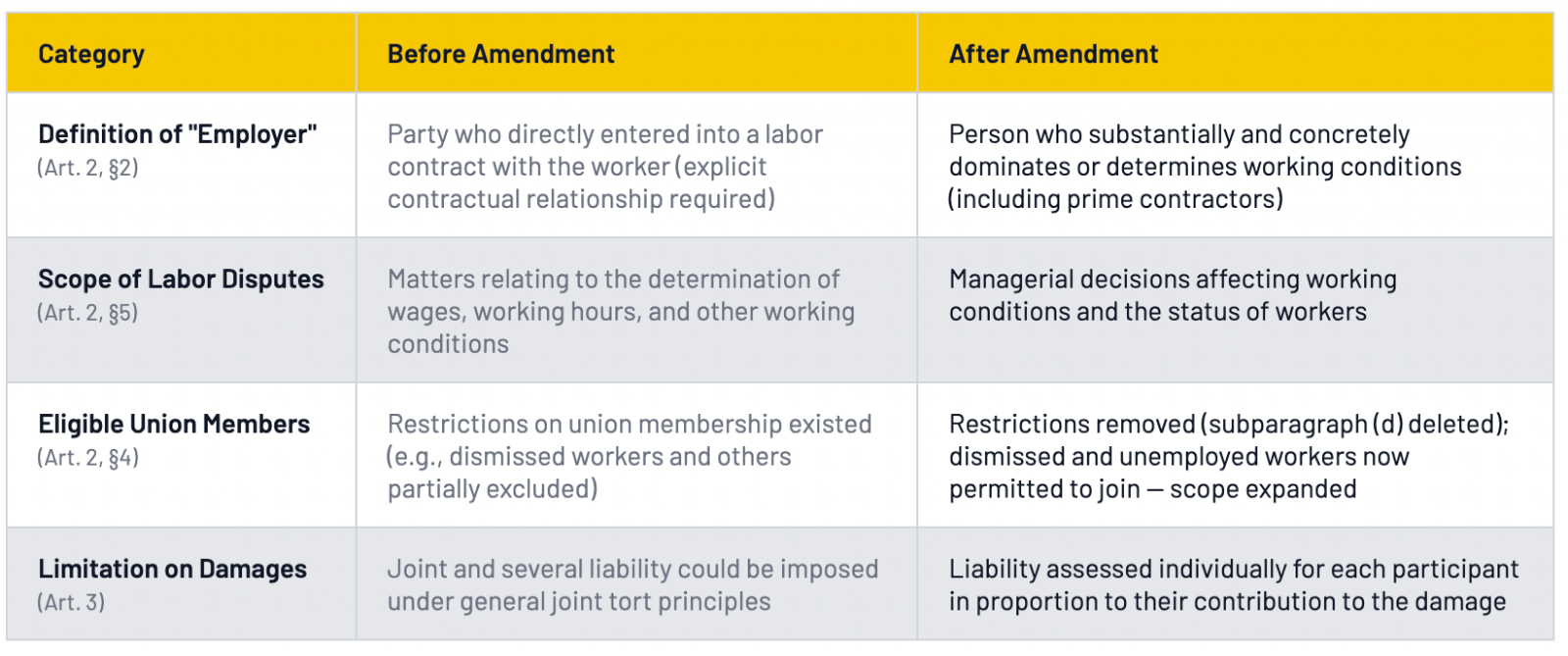
Analysis The ‘employee’ POV: What the Yellow Envelope Act changes for labor and unionsBeyond expanded bargaining rights, the amendment shifts liability rules, union eligibility and enforcement leverage  Editor’s note: Part 1 of this series examined the employer side of the law’s implications. South Korea’s amended labor union law has drawn significant attention for its implications for firms — particularly how they assess de facto “employer” status and respond to union demands. Less examined is what the law changes for workers and unions — including how it expands bargaining leverage while lowering financial risks associated with collective action. The amendment extends beyond redefining who qualifies as an employer (사용자) and overhauls how strike-related damages are calculated, who bears the burden of proof and what constitutes a legitimate labor dispute under Articles 2 and 3. For the first time, certain violations of existing collective bargaining agreements (CBAs, 단체협약 위반) and “managerial” decisions that directly result in layoffs or “shifts in working conditions” or status are recognized as legitimate dispute agendas. The labor ministry’s guideline, issued in late February, attempted to clarify how these provisions are expected to work in practice. But as with the employer side, several key thresholds remain open to interpretation — and how unions test those boundaries will shape the law’s real scope in the coming months. Korea Pro breaks down the amendment’s major labor-side changes, where the guideline draws limits and where those limits are most likely to be contested. ‘EMPLOYEE’ OR NOT? A QUICK RECAP Before the amendment, a subcontracted worker’s right to collective bargaining (단체교섭) extended only to the company that signed their employment contract — the direct employer (계약사용자). Under the amended law, a worker whose conditions are substantially controlled by a primary contractor (원청) may now demand to bargain directly with that contractor, even without a direct employment relationship. Whether that right applies depends on three core tests outlined in the guideline:
None of these is individually determinative, and bargaining rights remain issue-specific. A worker may be able to demand negotiations over working hours but not over benefits where the primary contractor lacks direct control. Digital systems that shape daily work routines may also constitute structural control — an area likely to see broader interpretation in practice. The full amendment related to employer status is examined in Part 1. What follows focuses on what changes once that bargaining right is established — or contested.
SHIFTING THE DAMAGES CALCULUS Under the previous 1998 version of the law, unions and individual members could be held jointly and severally liable (연대책임) for the full amount of damages resulting from strikes. In practice, this meant a worker who participated in a strike could face claims based not on their own actions, but on the total losses calculated by the company. The Ssangyong Motors and Daewoo Shipbuilding disputes are among the most cited examples that contributed to the discussion that ultimately led to last year’s amendment. A 2023 Supreme Court ruling, which found that damages should be assessed individually based on each participant’s level of involvement in a labor strike, laid the groundwork for the revised Article 3. Under the amended law, liability is now assessed in “proportion” to each individual’s contribution to the damage — a shift to what the law terms “individual liability calculation (개별 책임 산정).” Consequently, the burden of proof now shifts to the employer, who must demonstrate each individual’s specific degree of involvement through documentation. While this does not grant blanket immunity or eliminate financial risk for unions, it reduces the likelihood that large, aggregate damage claims can be used as a deterrent to collective action — aligning more closely, at least on paper, with principles outlined in International Labor Organization (ILO) Convention No. 87. The ILO has consistently maintained that disproportionate sanctions and massive damages claims function as a structural deterrent, effectively nullifying the right to organize and engage in collective action. By moving away from collective punishment toward individual accountability, lawmakers partly sought to ensure that the financial consequences of a strike do not become a tool for union-busting. This is on top of how the July 2021 amendment removed restrictions on union membership for dismissed (해고자) and unemployed (실직자) workers. Previously, workers dismissed during a dispute could lose their union status — a limitation that sat in tension with ILO Convention No. 87. By eliminating these exclusions, the amendment ensures that laid off workers do not automatically lose representation during or after disputes. 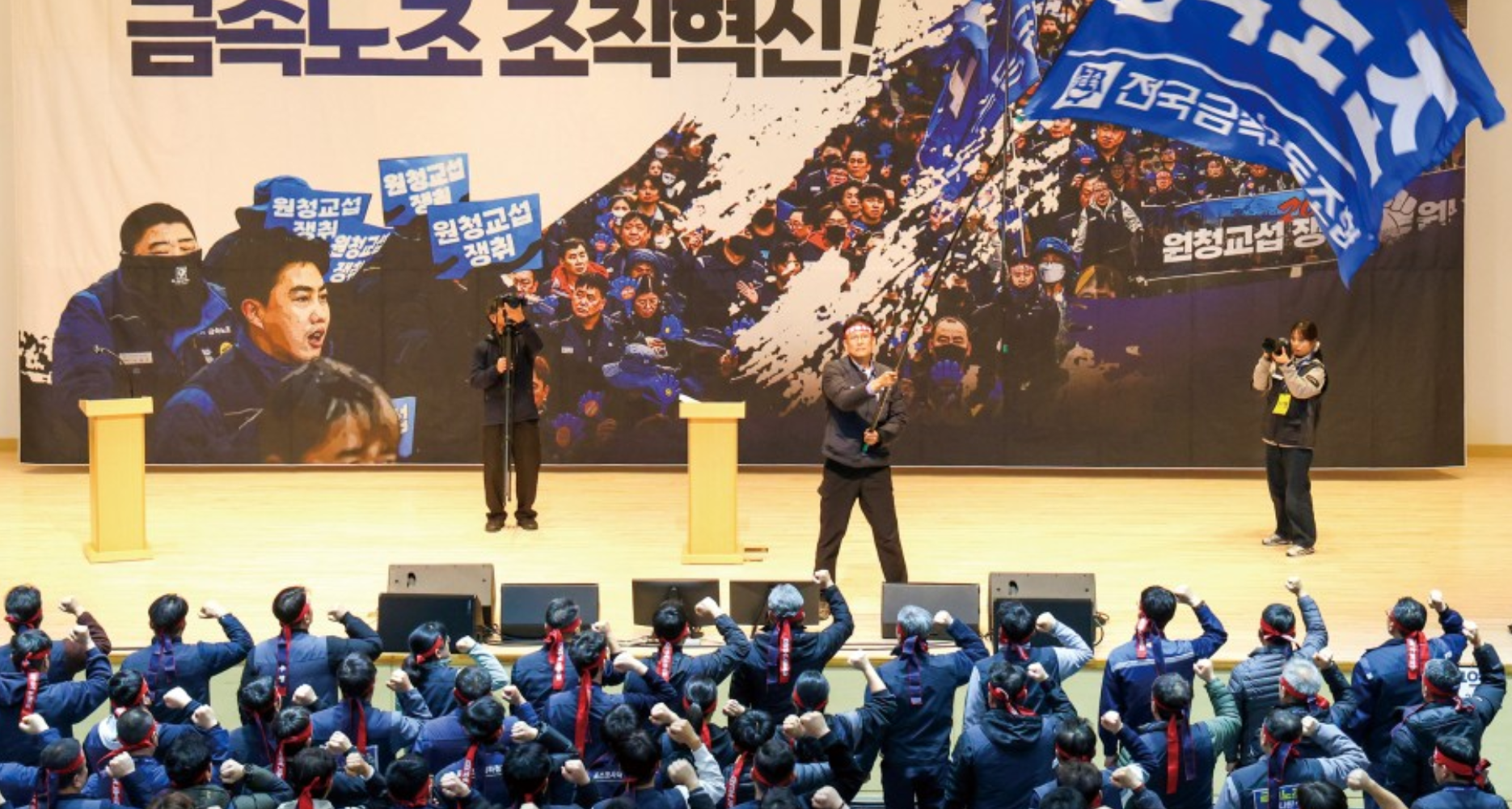 Korean Metal Workers’ Union, March 3, 2026 | Image: Korean Metal Workers’ Union THE WAGE GRAY ZONE The ministry guideline takes a cautious approach to wage disputes — and this is likely to become a key battleground. The guideline states that wages are “generated and determined between the contractual employer (계약사용자) and the relevant worker.” Unless there is clear evidence that a non-contractual employer has “substantially and concretely” determined wages, a subcontractor union cannot compel primary contractors to negotiate on pay. Early union filings suggest that this boundary is already being tested. For instance, the metal workers’ union have already demanded wage negotiations with primary contractors in the construction industry. Their rationale is that primary contractors have substantial and structural control over labor safety, working environment and working hours, which directly impact workers’ wages. A Jan. 2024 Seoul High Court ruling involving a major parcel delivery company will serve as an important legal precedent on such matters. The court found that a pre-set delivery fee structure, imposed unilaterally and without negotiation, constituted structural control over what were effectively drivers’ wages. How broadly this reasoning is applied will be a key point of contention. A NEW TRIGGER: CBA VIOLATIONS The amendment introduces a new trigger for labor disputes: a de facto employer’s violation of an existing bargaining agreement is now itself a defined basis for a legitimate labor dispute. The amended Article 2, Clause 5 defines an employer’s “clear violation” (명백한 위반) of a CBA — covering wages, hours, rest, holidays, dismissal procedures and safety — as grounds for initiating a labor dispute and seeking mediation through the Labor Relations Commission. The guideline defines “clear” narrowly. It applies where “the objective meaning of the collective bargaining agreement text is unambiguous and leaves no room for interpretive dispute, yet the employer fails to comply without justifiable cause.” This includes where “the employer acknowledges the violation yet fails to comply,” or where “the violation is objectively confirmed during the mediation process.” Interpretive disputes remain outside this provision and must be resolved under Article 34. For unions, this represents a practical enforcement upgrade. Cases that previously required civil or administrative litigation can now be escalated to Labor Relations Commission mediation, which is likely to be faster and less costly.  ROK President Lee Jae Myung delivers an address about the government’s 2026 budget proposal at the National Assembly, which main opposition People Power Party lawmakers boycotted, Nov. 4, 2025 | Image: Blue House THE PUBLIC SECTOR CARVE-OUT One of the more consequential aspects of the guideline concerns its treatment of government agencies and public institutions as potential non-contractual employers (계약외사용자). Unions representing care and social service workers have already filed demands against dozens of ministries and local governments, arguing that budget allocations and policy guidelines constitute structural control (구조적 통제) over their working conditions. However, the guideline’s response adopts a restrictive — and potentially contentious — stance. It states that where working conditions are determined through laws or budgets approved by the National Assembly, these fall under public policy decisions and are not directly subject to labor-management bargaining. This position introduces a tension. While the law expands the concept of employer responsibility in the private sector, its application to the public sector remains more limited — raising questions about consistency in how “control” is interpreted. The ILO has noted in various country reviews in the past, however, that public sector workers’ bargaining rights, while subject to legitimate fiscal constraints, should not be structurally subordinated to budgetary convenience. BRIDGING THE GAP: INTERNATIONAL STANDARDS Overall, the amendments to Articles 2 and 3 move South Korea closer to the “effective enforcement” of collective bargaining rights envisioned under ILO Conventions No. 87 and 98. By shifting liability toward individual accountability, expanding union eligibility and strengthening enforcement mechanisms for CBAs, the law reduces some of the structural barriers that previously constrained collective action. However, the public sector carve-out — particularly around wage negotiations and the scope of managerial decisions — remains a glaring blindspot that will likely face significant legal and social pushback. How these ambiguities are interpreted in early disputes — and how consistently those interpretations are applied — will determine whether the law expands bargaining rights in practice or produces uneven outcomes across sectors. Edited by John Lee © Korea Risk Group. All rights reserved. 
|

October 28, 2026Oct 28, 2026

Never be sidelined again
 SHARE
SHARE COPY LINK
 X
X MASTODON