  
Analysis Egg-freezing surge in South Korea signals deeper demographic woesEfforts to encourage childbearing clash with concerns over medical risks and social impact  In South Korea, the increasing trend among unmarried women to freeze their eggs serves as yet another signal that reflects deeper concerns about declining birth rates and the pressures of modern life. Lim Yoo-ra chose to freeze her eggs when she was 36. Without a romantic partner at the time, she saw egg freezing as a proactive measure to preserve her genetic lineage amid life’s uncertainties. Although Lim married a year later and is now the mother of a child whom she conceived without the use of her frozen eggs, she still stands by her decision and continues to recommend the procedure to others. “It felt like it expanded my life choices as a woman, enhancing my confidence. I’m convinced it was the right move,” Lim said. She remains open to utilizing her frozen eggs for a second child in the future. Lim’s choice highlights a growing movement among Korean women to secure their reproductive futures amid economic and societal uncertainties. This choice, supported by stories of celebrities and government subsidies, mirrors a broader societal transition toward delayed marriage and childbearing, highlighting the challenges and opportunities this represents for individuals and policymakers alike. In recent years, Cha Medical Center, a leading hospital specializing in fertility treatments, has witnessed a dramatic rise in egg-freezing procedures, from 599 in 2019 to 1131 in 2022. This nearly twofold increase is indicative of a wider trend that gained momentum around 2020, coinciding with the global pandemic. “The technology has been available for nearly two decades, but the exponential growth began around 2020, during the COVID-19 era,” Han Se-yeol, the head of the Cha University Fertility Center (CUFC) Ilsan, told Korea Pro, pointing to an annual caseload of approximately 1,500.  A baby inside a neonatal intensive care unit | Image: Vidal Balielo Jr. via Pexels NOT AN EASY PATH The egg-freezing procedure involves a series of complex steps. The process begins with hormone injections to stimulate over-ovulation, necessitating self-administration and frequent monitoring of follicle development. Approximately two weeks later, eggs are harvested under anesthesia after which they are immediately frozen and stored at extremely cold temperatures. This path, though increasingly popular among women aiming to preserve their reproductive options, is fraught with challenges. CUFC Ilsan reports that of the nine women who proceeded with thawing their frozen eggs to attempt to fertilize them in the past three years, only four were successful. This statistic underscores the variable success rates of egg freezing, highlighting the importance of age as a critical factor. “Optimally, freezing eggs before the age of 35 is best, but in reality, many women make this decision later,” said Han. “Given all factors, we recommend the age range of 34 to 37 for egg freezing.” The process is not without its physical tolls. Participants describe significant discomfort and emotional stress, with some experiencing severe side effects requiring medical intervention. For instance, Lim told Korea Pro that she experienced an intense stomach ache requiring hospitalization. Another woman, Kim Su-yeon, said that she went through emotional and physical distress during and after the procedure. “It was just awful,” Kim recalled. “The month following the treatment is a blur. I didn’t feel like myself during that time.” 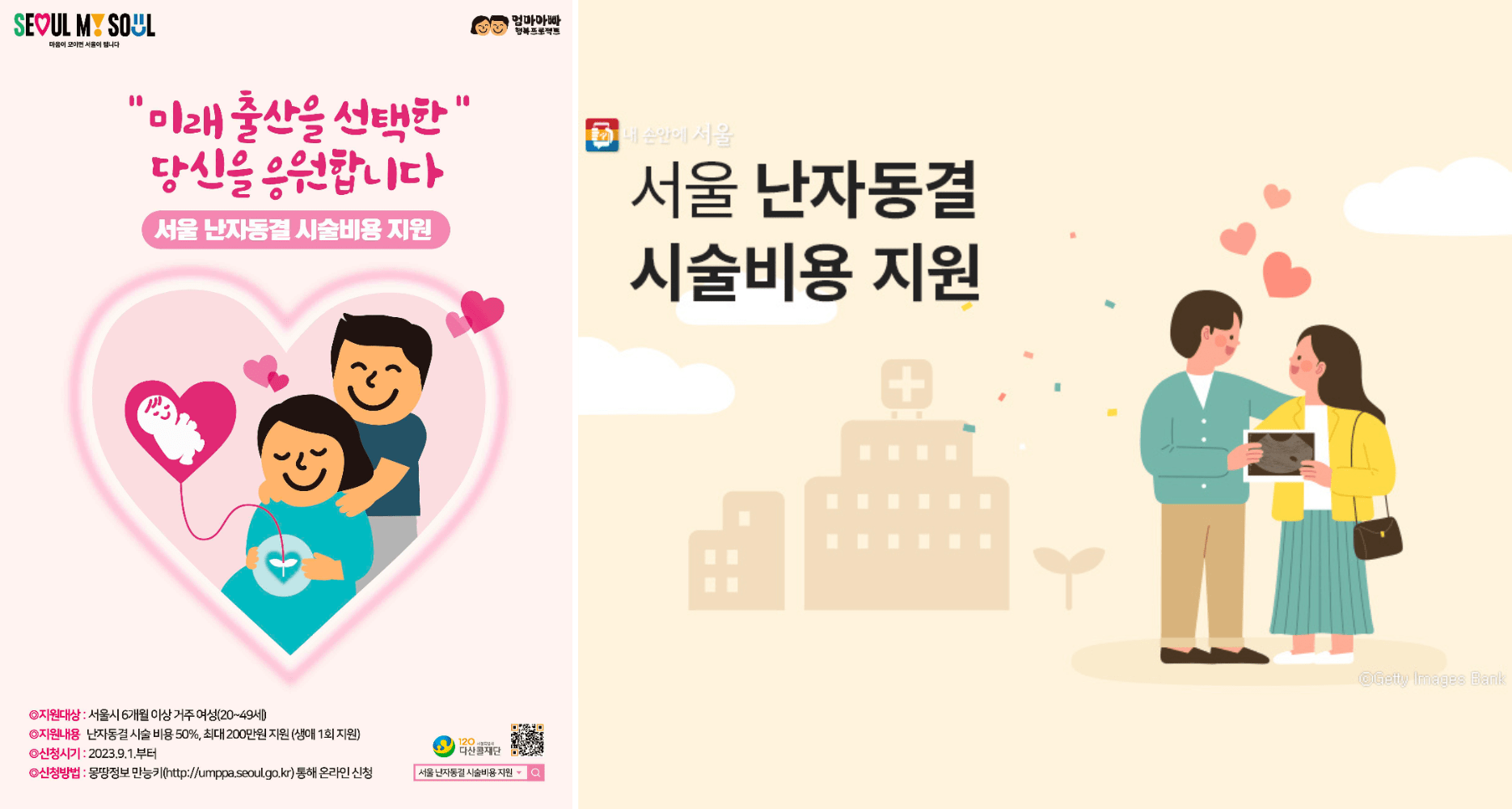 Seoul’s egg-freezing aid posters portraying couples who seek to have children | Images: Seoul City Hall SUBSIDIES AND CONTROVERSY The financial aspect of egg freezing presents a significant hurdle, with each cycle of retrieval and storage commanding fees between $3,000 to $4,000 (4 and 5.5 million won), alongside an annual storage cost of $150 to $230 (200,000 to 300,000 won). In an effort to alleviate these costs, the Seoul Metropolitan Government launched a subsidy program in Sept. 2023 for 300 women aged 20 to 49, covering half the expense of egg-freezing treatments up to two million won per person. This initiative, described by a Seoul government official as “the most realistic” solution to address the nation’s plummeting birth rates, underscores the urgency of the demographic crisis. With South Korea’s birth rate dropping to a historic low of 0.78 in 2023 and the capital’s rate even lower, the government’s intervention aims to directly support individuals’ reproductive plans. In response to these alarming figures, the Seoul City Council, in a recent New Year’s press conference, recommended removing income limits from all policies addressing the low birth rate issue. However, this policy has ignited debate, particularly around the implications of promoting egg freezing as a viable path to parenthood amid uncertain success rates. Critics, like Choi Anna from the National Medical Center, expressed concern that such measures might foster unrealistic expectations about the timing of childbirth, overshadowing the health risks associated with later pregnancies. “The government’s move could send the wrong message to the younger generation that they can have a baby when they want,” Choi Anna, director of the Fertility Center at the National Medical Center, told Korea Pro. She emphasized the health risks associated with pregnancies later in life, such as heightened risks of high blood pressure, diabetes and complications during childbirth, which are often overlooked. A 2020 study from the Korean Journal of Medical Ethics supports this concern, suggesting that the promotion of egg freezing could inadvertently encourage delayed childbearing, risking potential infertility and increased social costs. Choi criticizes the government’s strategy as an ineffective response that overlooks the underlying social and financial barriers to family formation, relying instead on medical technology. “The actual use of frozen eggs is less than 10%, indicating that many who opt for egg freezing do not proceed with childbearing plans,” she said. “The goal should be pregnancy, not just freezing eggs.” Despite these criticisms, the sense of urgency around the country’s declining birth rates seems to justify the expansion of the subsidy program. The Seoul government plans to double the number of recipients for the funding this year. “With discussions around the country’s potential decline due to the low birth rate, there’s an undeniable sense of crisis compelling the government to devise policies that support women’s reproductive choices,” noted Lee Byoung-hoon, an emeritus sociologist professor at Chung-Ang University. Despite lingering skepticism about the efficacy of egg freezing, Lee anticipates its continued rise in popularity, particularly fueled by governmental financial incentives and increased recognition through celebrities sharing their personal experiences in the media. Lee Min-jung, 35, who is currently single, reflects this trend. “I never envisioned having children, but I’m increasingly haunted by ‘what ifs,’” she said. “The abundance of information and reduced costs are tilting my decision in its favor.” Edited by John Lee © Korea Risk Group. All rights reserved. 
|

October 24, 2026Oct 24, 2026

Never be sidelined again
 SHARE
SHARE COPY LINK
 X
X MASTODON