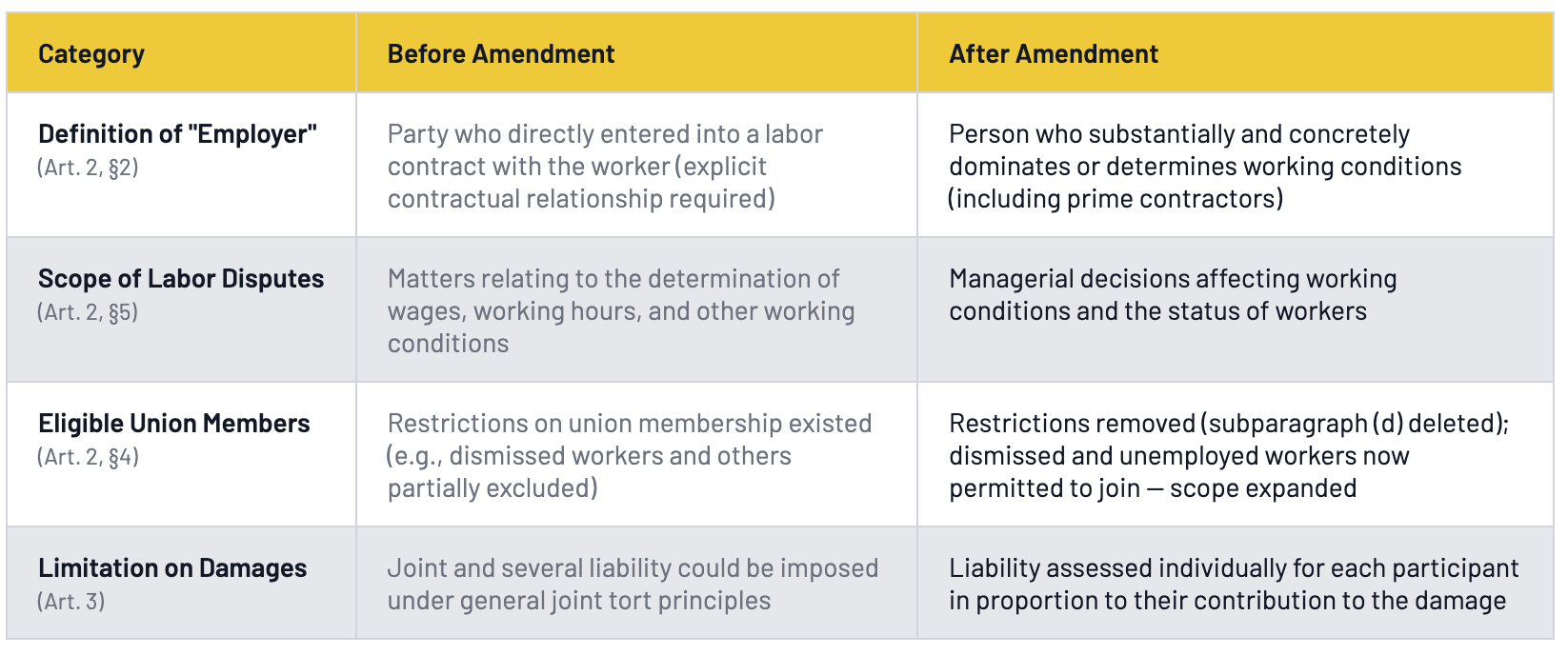
Analysis The ‘employer’ POV: How South Korea’s Yellow Envelope Act creates new gray zonesGuidelines leave key thresholds unclear, raising uncertainty over when firms must bargain as de facto employers  South Korea’s controversial Yellow Envelope Act took effect earlier this month, and in just three weeks, around 700 union demands have been filed asking primary contractors to come to the negotiation table. Firms and public institutions with subcontractors, regardless of sector, are now rushing to assess what it means to be considered a “de facto employer (실질적 사용자)” under the new law. Both businesses and unions have called for clarification, reflecting the significant room for interpretation embedded in the law. In response, the labor ministry issued a 50-page guideline in late February, attempting to define what constitutes “substantial and concrete” control — though key thresholds remain open to interpretation. Foreign corporations, in many cases, will likely not be exempt — any entity with South Korean subcontractors, subsidiaries or branch offices is broadly expected to fall within scope. Korea Pro breaks down how the ministry guideline interprets “substantial and concrete (실질적, 구체적)” dominance (지배) and decision-making authority (결정) over subcontracted workers’ “working conditions (근로조건)” and “status (지위)” — and how the scope of labor disputes now extends to “managerial decisions (사업경영상의 결정).” For instance, does a KakaoTalk chat room with subcontracted workers, or an app that tracks their shifts, constitute “employer” control? In many cases, yes — particularly where those tools are used to directly assign work or enforce performance.
‘EMPLOYER’ OR NOT? The amendment shifts accountability away from formal contracts and toward actual influence over working conditions. The ministry guideline attempts to clarify what that influence means in practice, but, crucially, it does not fully resolve where the line is drawn. Before the amendment, only the party that signed the employment contract was treated as the employer. The new framework reflects the reality that, in modern supply chains, while the entity with the most control over how work is performed might not be the direct employer, it is, for all intents and purposes, the prime contractor. For instance, if a foreign company’s Seoul branch outsources building management but determines the individual security guards’ exact shifts — with the subcontractor having little discretion — that company may be treated as the employer. ECONOMIC DEPENDENCY One key test is economic dependency — but what constitutes “dependency” remains loosely defined. If a logistics subcontractor processes nearly all of its delivery volume for a single contractor and does not work with other clients, termination of that contract may effectively shut down the business. In such cases, the primary contractor is now viewed as the de facto employer. If, however, the subcontractor has multiple clients, the relationship is less likely to be considered dependent. A cold-chain logistics firm with pharmaceutical certifications and a diversified client base, for example, retains meaningful autonomy. The distinction is not always clear in practice, and may ultimately depend on how regulators interpret the degree of reliance. 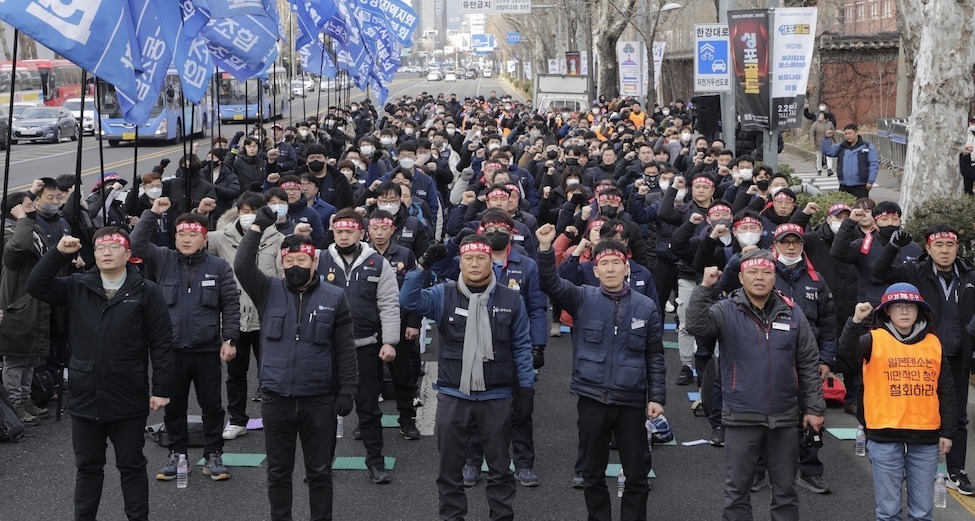 Korean Metal Workers’ Union members protest against the Yoon administration’s labor policies, Feb. 16, 2023 | Image: Facebook FACILITY AND EQUIPMENT OWNERSHIP Control over facilities and equipment is another factor — though ownership alone is not determinative. If a primary contractor owns the physical space in which subcontracted workers operate — such as a department store where subcontracted workers cannot perform their duties independently — that may be interpreted as structural control over certain working conditions. Similarly, in manufacturing settings where the primary contractor owns the production line machinery, quality inspection systems and raw material supply chain, and subcontracted workers operate entirely within that environment, the subcontracting company has little meaningful operational autonomy. In such cases, the primary contractor will likely be treated as the employer for matters tied to that production environment — though the boundary between ownership and control remains subject to interpretation.  Labor Minister Kim Young-hoon inspecting illegal subcontracting at construction sites, Sept. 18, 2025 | Image: Ministry of Employment and Labor ‘DIGITAL’ CONTROL? De facto “domination” or “control” through digital systems is one of the most consequential — and vaguely defined — aspects of the guideline. For instance, an international ride-hailing platform that directly enforces optimal routes, monitors subcontracted workers’ performance in real time and enforces compliance through its system may be exercising structural control, even without direct verbal instruction. Similarly, a retail or hotel brand that uses centralized systems to fix subcontracted workers’ schedules and trigger alerts for deviations may be performing functions typically associated with direct employment. While the guideline does not explicitly address messaging apps, the logic extends naturally. Hence, if a logistics manager runs a KakaoTalk group chat assigning routes, setting deadlines and monitoring performance — and the subcontracting company has no meaningful role in those decisions — that communication channel itself may be interpreted as a mechanism of “substantive” control, making that logistics manager the de facto employer. IT’S OKAY TO MANAGE, BUT WHERE IS THE LINE? However, not all oversight triggers bargaining obligations. The key distinction is between “structural control,” which constrains the subcontractor’s autonomy in a fundamental and sustained way, and “general supervisory authority (일반적 지시권),” which is routine management of the subcontractor for the purpose of fulfilling a contract. For instance, requesting that a subcontractor redo substandard work is considered general supervisory authority. However, dictating staffing levels, schedules and requiring subcontracted workers to log their tasks in a proprietary app is considered structural control. Similarly, flagging delivery failures is supervisory. Pre-assigning routes, setting quotas and penalizing performance of individual workers through system-driven metrics crosses into employer-like authority. In practice, the distinction depends on whether the subcontractor retains meaningful discretion — a determination that may vary case by case.  A Coupang delivery truck parked next to a plane, Sept. 25, 2023 | Image: Coupang PERFORMANCE REVIEWS: A KEY GRAY AREA Performance management is one of the most ambiguous areas. Reviewing aggregate performance reports submitted by a subcontractor is generally supervisory. But systems that evaluate individual workers directly — and tie those evaluations to continued employment or compensation without intermediary control — may be interpreted as exercising employer authority. Thus, a bank reviewing call center outcomes is different from a bank scoring individual agents in real time and influencing their continued placement. Similarly, a private equity firm that receives quarterly compliance reports from a subcontracted back-office team and flags areas for improvement is general supervisory authority. But a firm whose system auto-assigns each subcontracted analyst’s daily task queue, tracks completion against unilaterally set benchmarks, and docks the subcontractor’s fee for any shortfall is structural control. The difference lies in whether the subcontractor remains the decision-maker — a distinction that may not always be clear in practice. 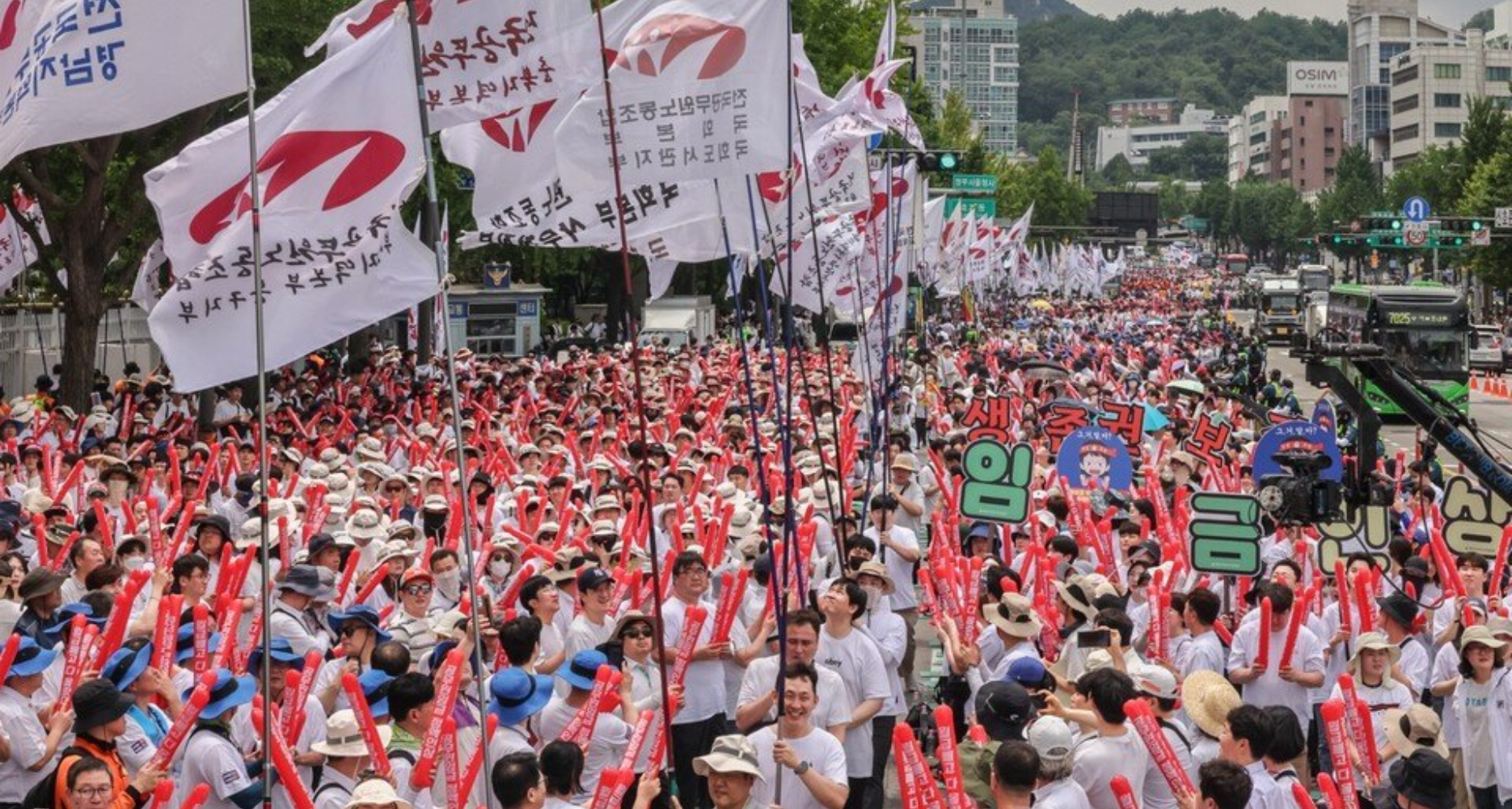 South Korean workers protest for higher wages, July 8, 2024 | Image: Korean Confederation of Trade Unions via Facebook M&A AND MANAGERIAL DECISIONS Perhaps most importantly, a company’s decision to lay off workers is now a legitimate target of union negotiations. Specifically, Article 2, Clause 5 now defines labor disputes to include not only wages, hours and welfare, but also managerial decisions that affect those working conditions. An M&A decision itself does not automatically allow workers to demand a seat at the table. The guidelines stipulate that management’s decision to merge, spin off, sell or acquire fall within protected managerial discretion. A union cannot demand a seat at the table simply because a company divests a non-core subsidiary. However, if that M&A decision produces an “immediate” and “concrete” change in workers’ conditions, such as layoffs, forced reassignments or what the guideline describes as “a substantial increase in labor intensity through changes to work equipment or processes,” unions can demand to negotiate. 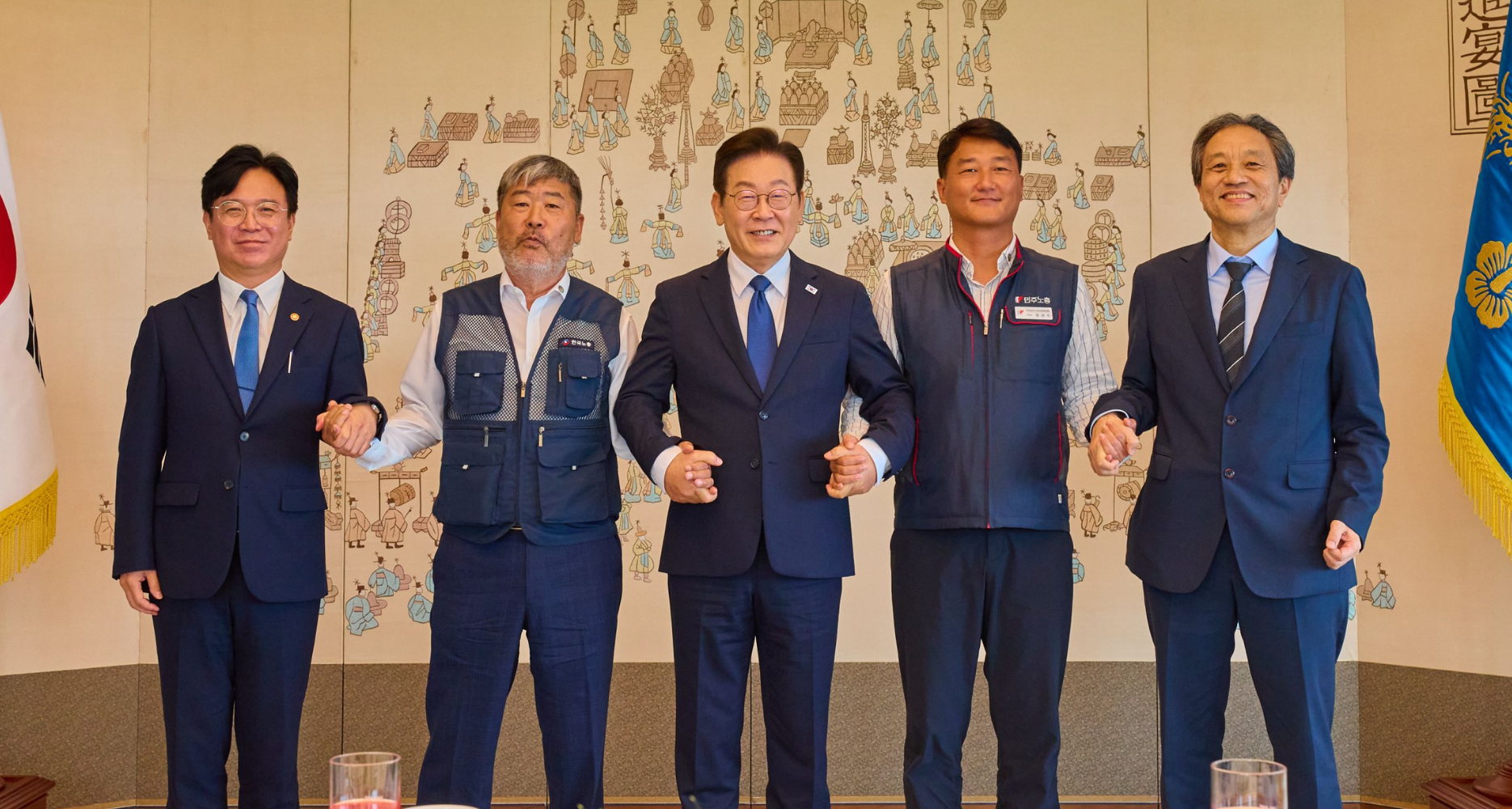 ROK President Lee Jae-myung (center) takes a commemorative photo with Yang Kyung-soo (right), chairman of the Korean Confederation of Trade Unions, and Kim Dong-myeong, chairman of the Federation of Korean Trade Unions, Sept. 4, 2025 | Image: Blue House ‘EMPLOYER’ STATUS IS ISSUE-SPECIFIC Being recognized as an employer under the amended law does not automatically extend across all aspects of the business. The guideline indicates that employer status can be determined on an issue-by-issue basis. For instance, a prime contractor that dominates subcontracted workers’ working hours may be considered the employer for working hours but not for welfare benefits or compensation. This issue-specific structure means that when unions demand to negotiate with the primary contractor, the first thing that needs to be determined is the scope of what the unions can legitimately demand. The guideline identifies six domains — labor safety, working environment, welfare benefits, working hours, work methods and compensation — each requiring its own assessment of structural control. A primary contractor delineating and proving which domains it actually controls, and which remain within the subcontractor’s discretion, is now one of the most important things a prime contractor must do. 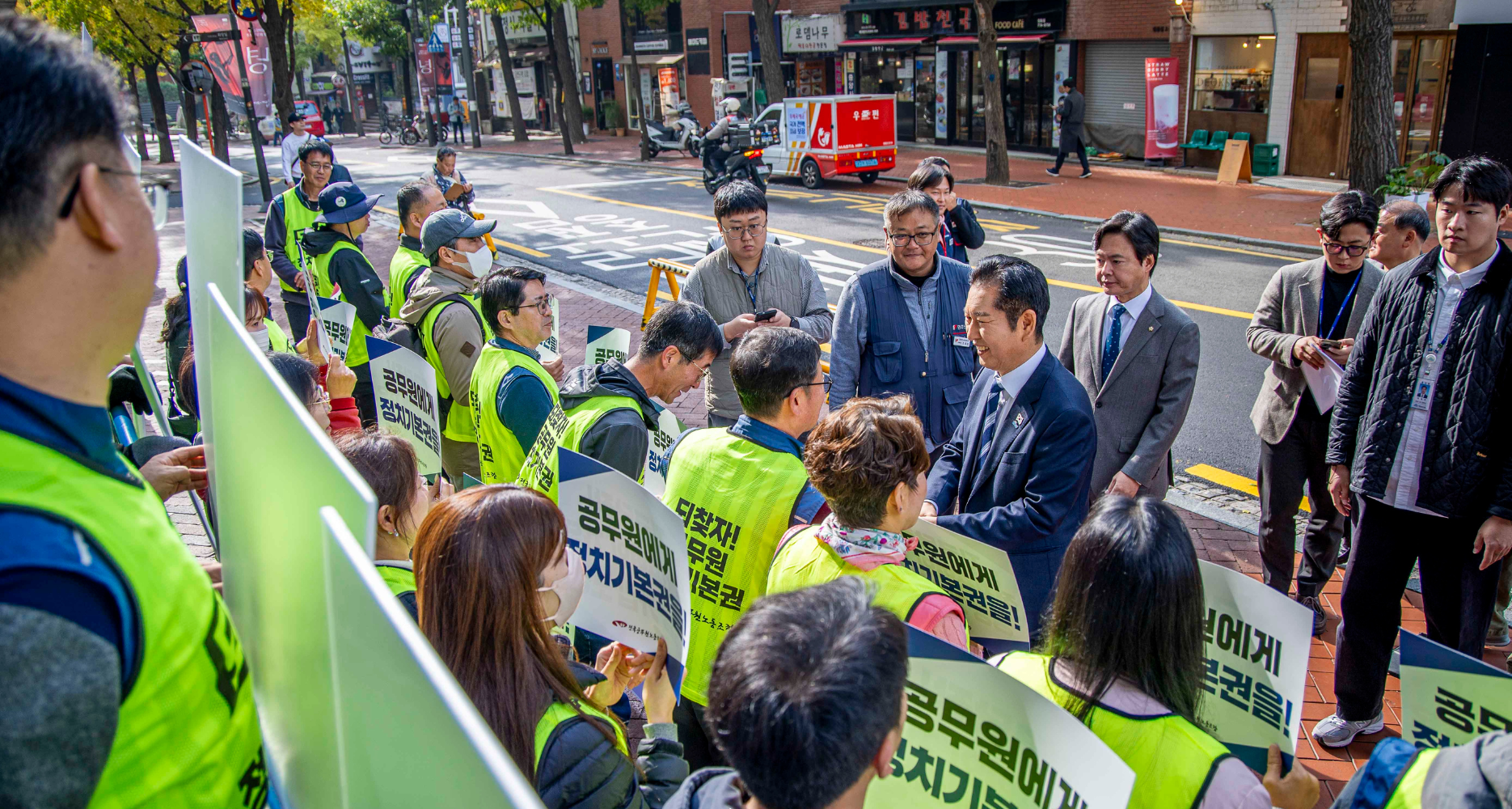 Ruling Democratic Party leader Jung Chung-rae meets with members of the Korean Confederation of Trade Unions, Nov. 6, 2025 | Image: Democratic Party of Korea CONCLUSION: START WITH THREE MAIN LITMUS TESTS Before engaging with any union demand — or assessing the legal exposure of any operational decision — three questions are worth stress-testing internally.
Primary contractors must determine which conditions — hours, safety standards, pay structure, workload pace — genuinely fall under their systems or infrastructure versus those that remain under the discretion of the subcontracting company.
Strategic decisions that only “vaguely” or “potentially”affect workers still fall under the management’s prerogative and are thus protected. The obligation to bargain is triggered when the impact is direct and traceable to the primary contractor’s decision.
Individual grievances fall outside the scope of the law. However, if a primary contractor’s business decision is expected to “substantively and specifically” result in mass reassignments or layoffs, the company is legally obligated to respond to the subcontracted workers’ demand for negotiations. In many cases, the answers will not be clear-cut. With enforcement underway, how regulators interpret these questions — and how aggressively unions test those interpretations — will determine how far the definition of “employer” ultimately expands in practice. Edited by John Lee © Korea Risk Group. All rights reserved. 
|

October 02, 2026Oct 02, 2026

Never be sidelined again
 SHARE
SHARE COPY LINK
 X
X MASTODON