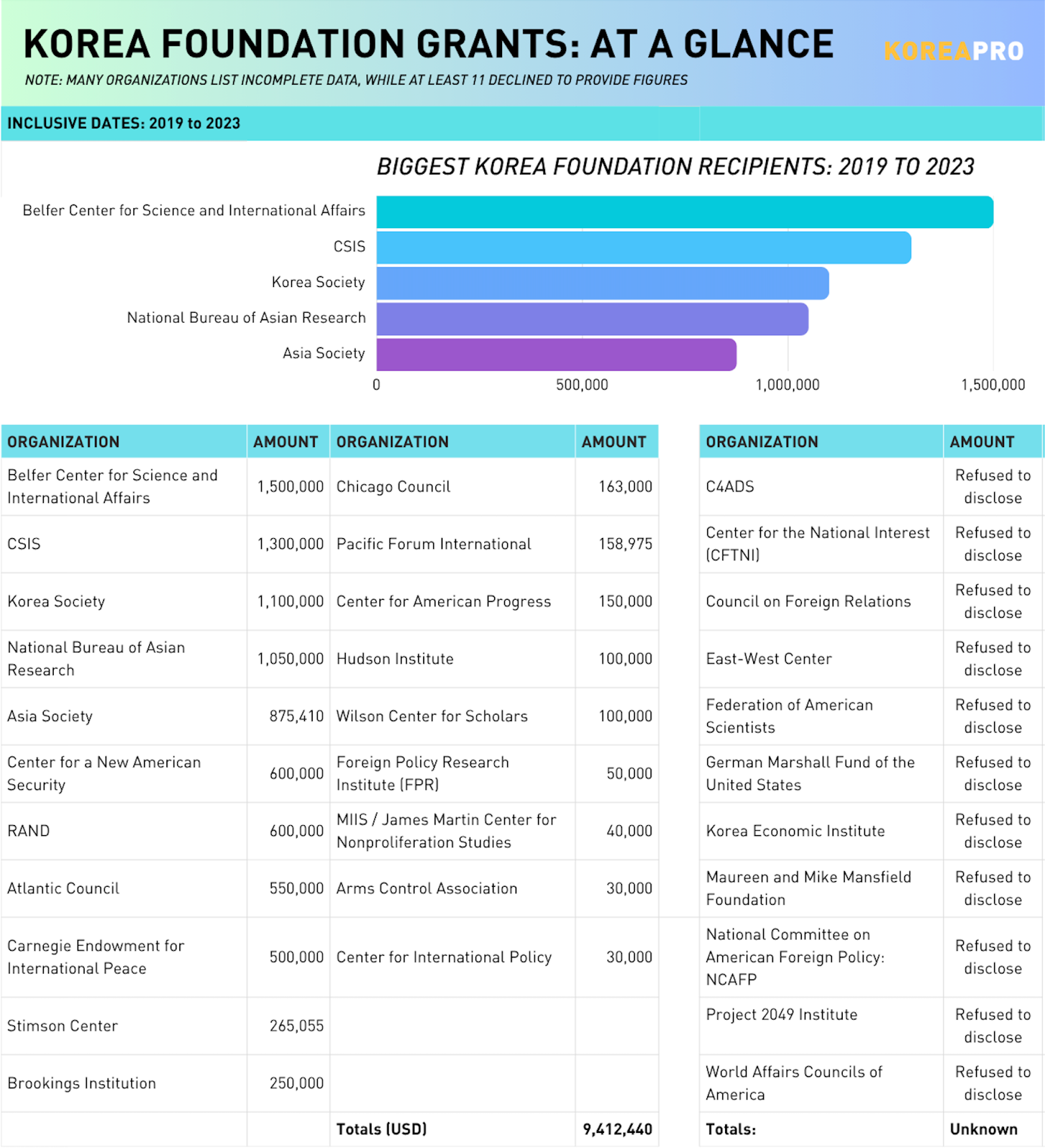
Analysis How South Korea gave $9.4M to US think tanks while evading foreign agent lawsInvestigation reveals Korea Foundation coordinates closely with Seoul to promote ROK interests, despite nonprofit status  Editor’s note: This article is the first in a two-part investigation into the Korea Foundation’s operations in the U.S. Part two will cover the organization’s funding for congressional travel to South Korea. A South Korean nonprofit affiliated with Seoul’s foreign ministry has funneled at least $9.4 million to U.S. think tanks in recent years, a Korea Pro investigation has found, making it one of the top global funders of American policy research despite avoiding registration under foreign agent laws. The findings show that the Korea Foundation (KF), which maintains offices in Washington and Los Angeles, provided grants to at least 31 different organizations from 2019 to 2023. But while KF claims to be a non-governmental body and a “nonprofit public institution,” Korea Pro’s findings show that the foundation is closely tied to the South Korean government and explicitly seeks to advance Seoul’s interests, at times pressuring scholars to promote the positions of the administration in power. KF’s activities reportedly caught the attention of U.S. authorities before, and last year’s indictment of Korea expert Sue Mi Terry, a former CIA analyst accused of failing to register as a foreign agent for Seoul, has exacerbated KF’s fears of being seen as a foreign agent itself, Korea Pro’s investigation found. However, multiple experts assessed that KF meets the legal threshold for mandatory registration as a foreign agent — a step that they said would clarify its role and allow U.S. audiences to better assess its influence on policymaking.
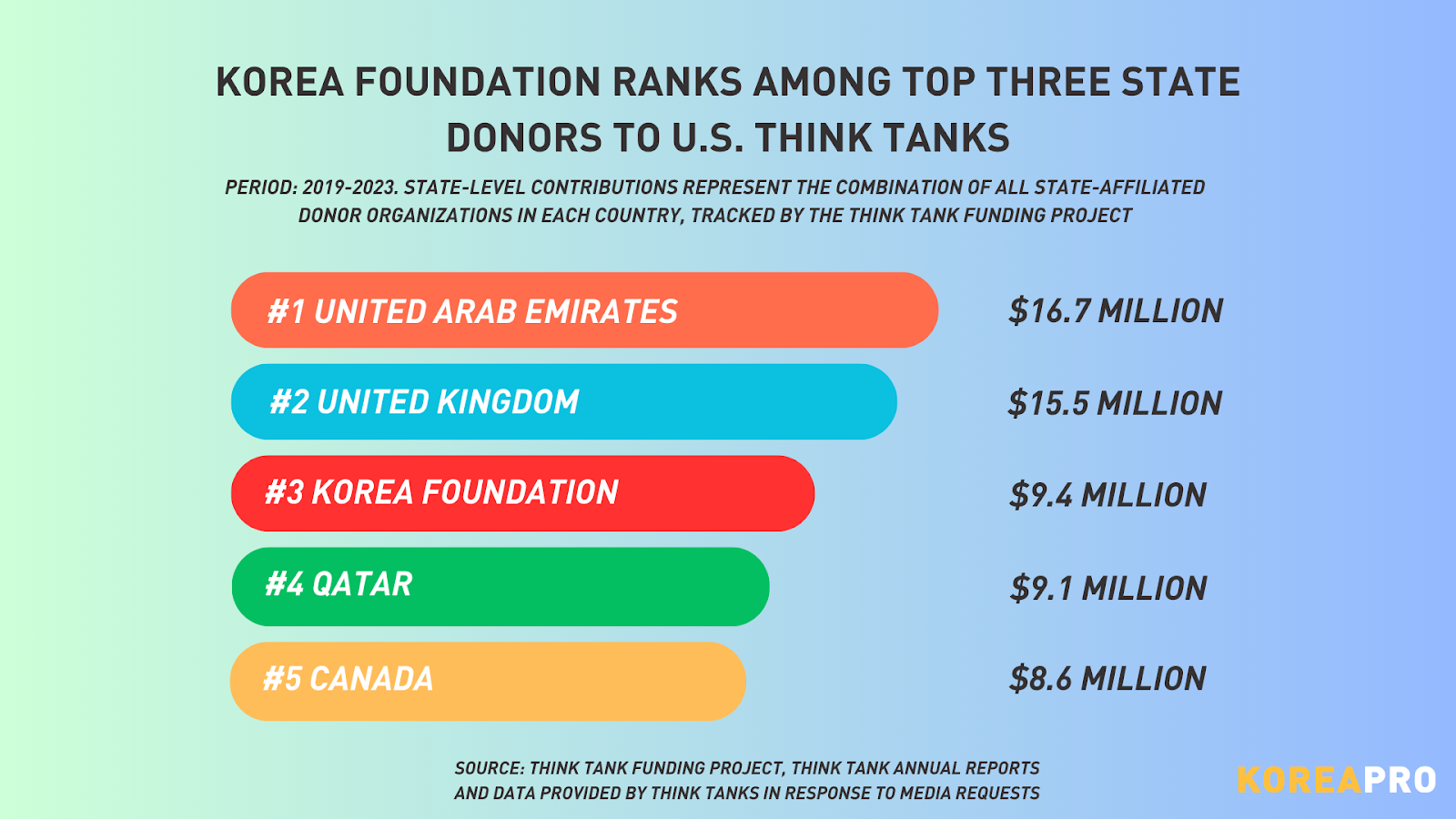
GOVERNMENT IN ALL BUT NAME $9.4 million might not sound like much in comparison to multi-trillion dollar U.S. budgets and defense projects that cost hundreds of billions. But in the world of think tanks, even this conservative Korea Pro estimate places the Korea Foundation (KF) in rare company. KF comes in at number three in the ranks of foreign government funders of American think tanks and policy institutions from 2019 to 2023, above nations like Saudi Arabia, Qatar, Canada, Japan, Sweden and Taiwan, according to data published by the Think Tank Funding Tracker. The real number is almost certainly much higher than $9.4 million: Korea Pro could only obtain donation data from 19 of the 31 policy research organizations mentioned in KF annual reports, relying on direct queries to recipient organizations and numbers published in their annual reports. KF itself declined to provide any figures in response to specific inquiries about the level of support it provides U.S.-based think tanks and research organizations. Despite ranking alongside some of the world’s highest spending nations, a KF spokesperson told Korea Pro that the foundation is “not a government entity.” “[We are a] ‘non-classified public institution’ that provides academic, cultural and policy research grant programs,” the spokesperson said.
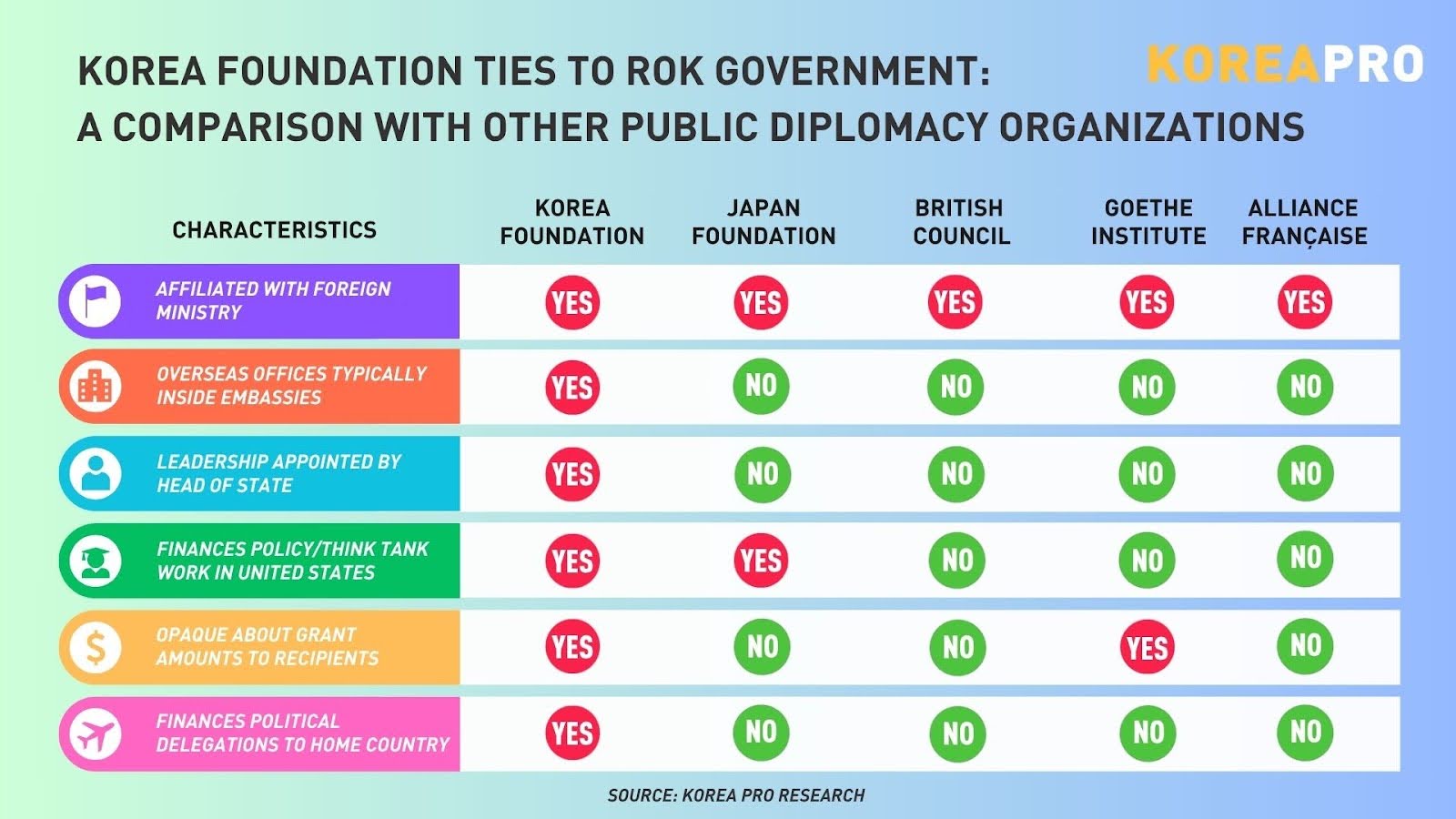
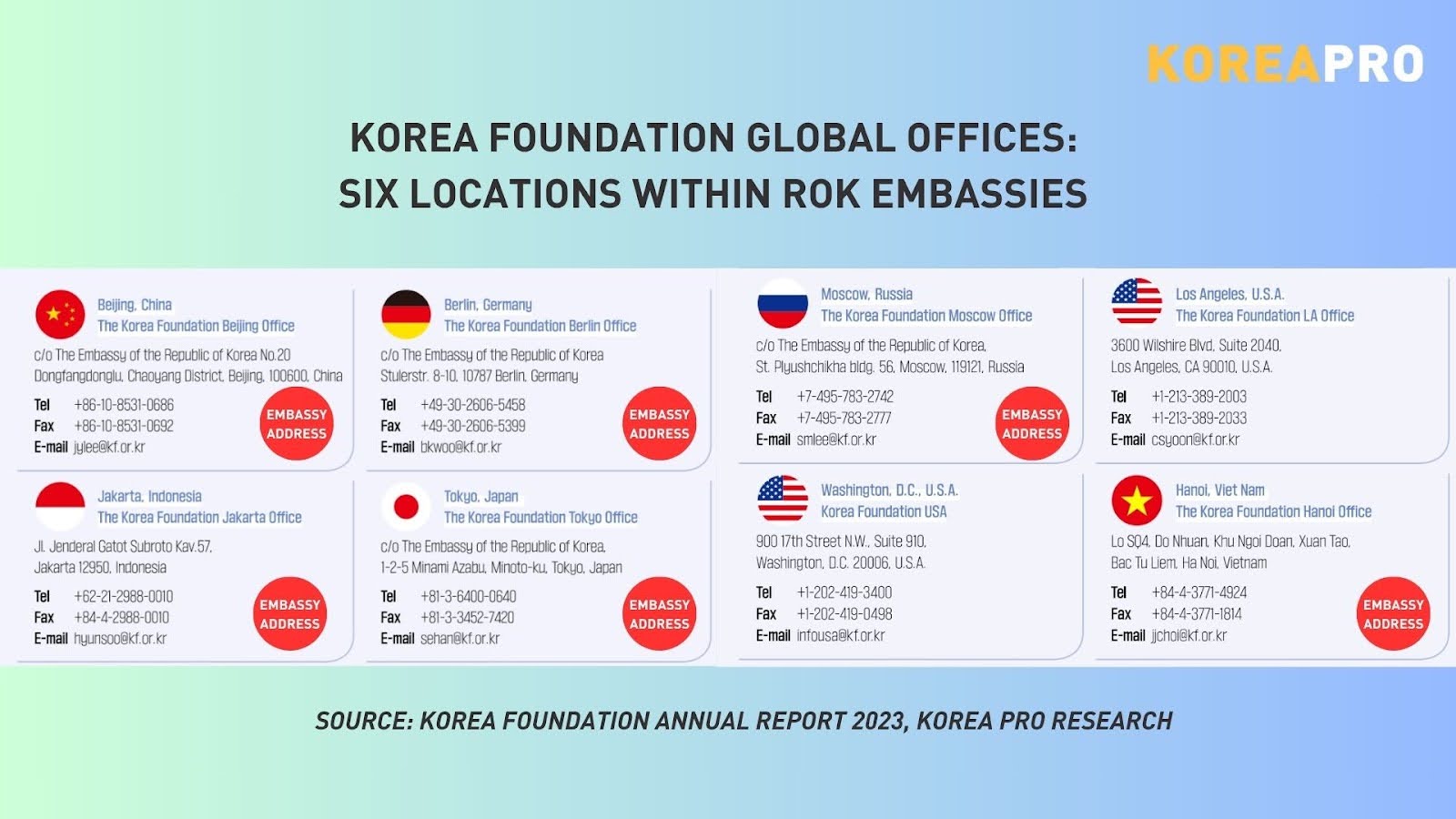
Established by South Korean law in 1991, KF is affiliated with the Ministry of Foreign Affairs. The organization’s funding comes primarily from government appropriations and passport taxes, with an annual budget exceeding $145 million. Notably, six of KF’s eight international offices operate from within South Korean embassies, though its two U.S. offices are located in separate addresses. Most tellingly, KF’s leadership is appointed directly by South Korea’s political establishment. Its board is selected by the foreign ministry, while its president requires ROK presidential approval.
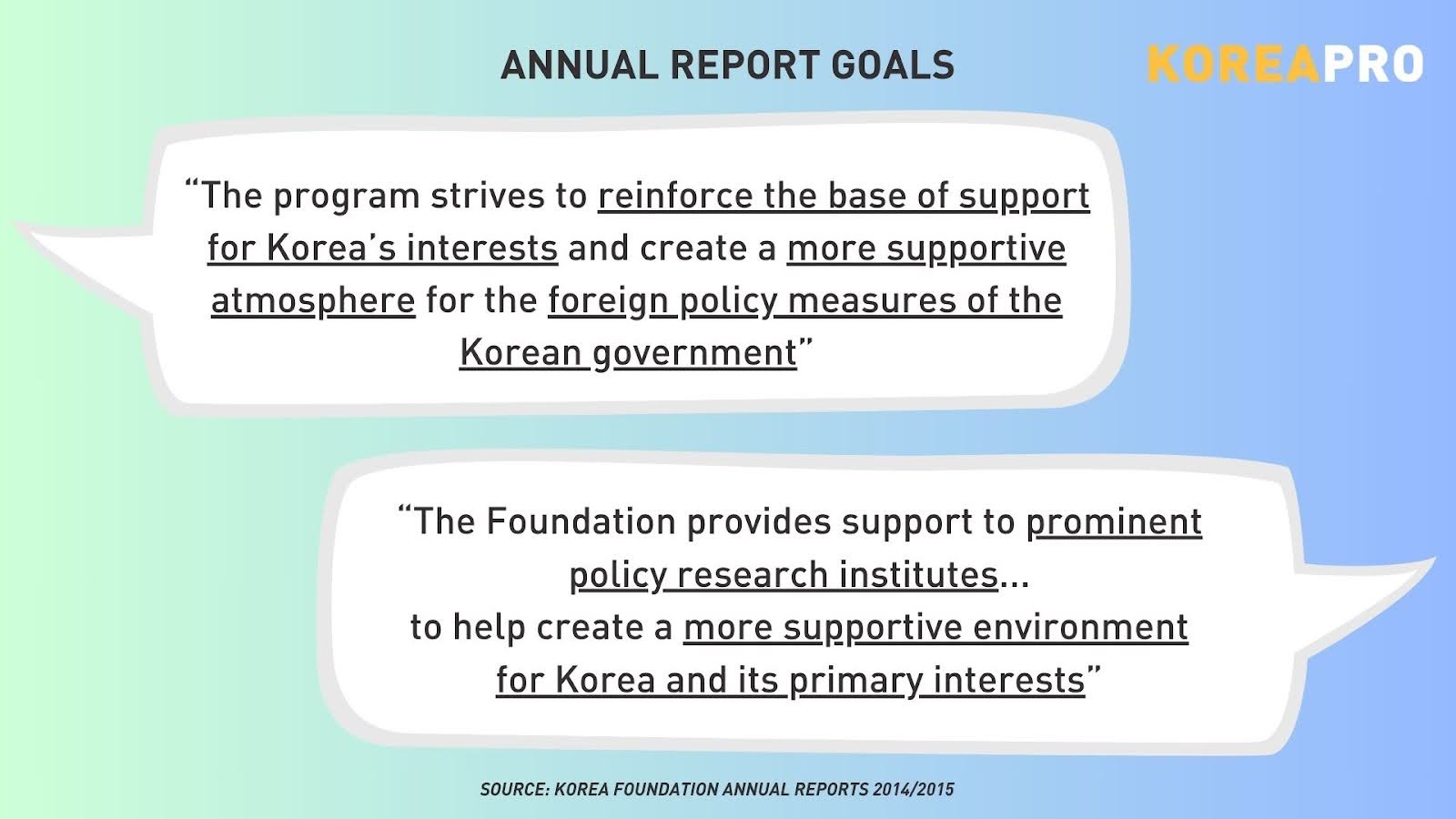
Importantly, KF’s annual reports make clear its intention to influence policy in South Korea’s national favor. Through its support of “prominent policy research institutes,” KF hopes to “create a more supportive environment for Korea and its primary interests,” the organization stated in 2015. Its annual report the previous year indicated that KF seeks to “reinforce the base of support for Korea’s interests and create a supportive atmosphere for the foreign policy measures of the Korean government.” A former KF staffer, speaking on condition of anonymity, confirmed that there is “tight” coordination in Washington between the ROK Embassy and KF operations, stating that “most of the guidelines … (come) from the Ministry of Foreign Affairs.” For example, when high-level Korean political figures visit Washington, KF coordinates with the embassy to schedule meetings with U.S. government and senate officials, as well as local think tank experts, the former staffer said. Multiple sources described how this structure enables top-down political influence. “If the office of president (of South Korea) initiates certain kinds of public diplomacy… (they) can mobilize the foreign ministry, National Intelligence Service and Korea Foundation … to support certain events,” explained a former high-level ROK government insider familiar with KF processes, speaking on condition of anonymity. While KF is one of several global public diplomacy organizations affiliated with a foreign ministry, most of which are not registered as foreign agents, the organization’s close ties to its host government and financing of policy work set it apart from its peers, which largely focus on language and cultural exchange.
The practical result is an organization that sets its priorities based on Seoul’s political goals, despite not identifying as a foreign agent lobbying for ROK interests. During the Moon Jae-in administration, KF funded projects promoting inter-Korean “peace” and “reconciliation.” One 2020 project, for example, received funding to promote “sovereign equality” as a solution to the “Korean Security Crisis,” with the stated goal of publishing articles in outlets like The National Interest and The Atlantic to “help revitalize the stalled policy debate in the United States and South Korea.” Under the conservative Yoon Suk-yeol government, such initiatives almost completely disappeared. “I know that, if needed, [KF] could be used as a tool to influence some scholars,” a former South Korean presidential office staffer told Korea Pro, speaking on condition of anonymity. Sometimes, the link between Seoul’s objectives and KF’s work is crystal clear. In April 2023, Harvard University’s Belfer Center for Science and International Affairs’ Korea Project hosted then-President Yoon for a speech during his state visit to the U.S. The Belfer Center was one of the largest recipients of KF funding at the time, and the foundation’s 2023 Management Evaluation report obtained by Korea Pro explicitly stated that its support for the Belfer Center “enabled the President of the Republic of Korea to deliver a speech at Harvard University for the first time.” Asked about government connections to policy-related programming, KF President Kim Gee-hwan told Korea Pro, “We don’t have anything further to add.” 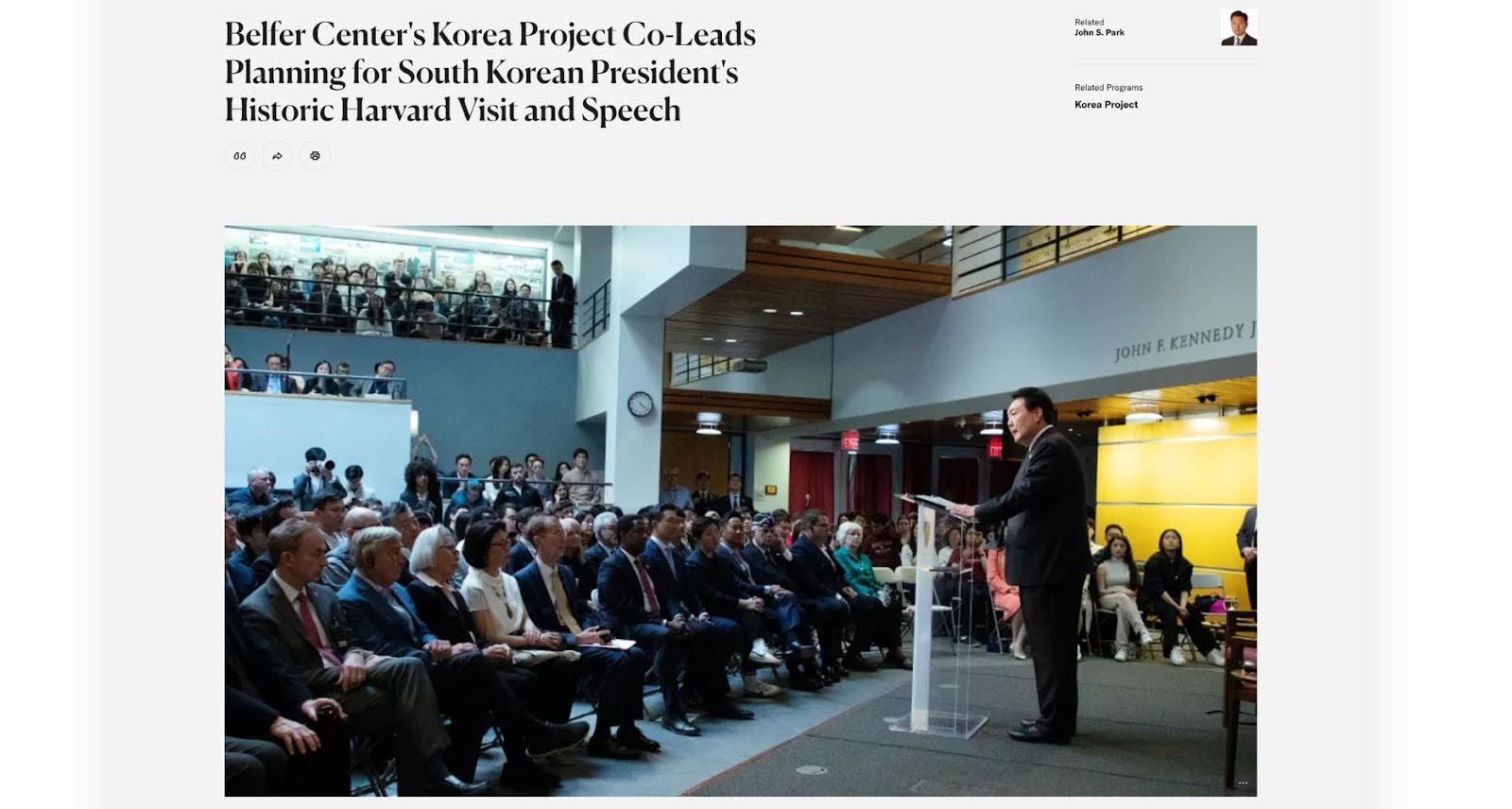 A screenshot from Belfer Center’s Korea Project website celebrating former South Korean President Yoon Seok-yul’s speech at Harvard University | Image: Belfer Center 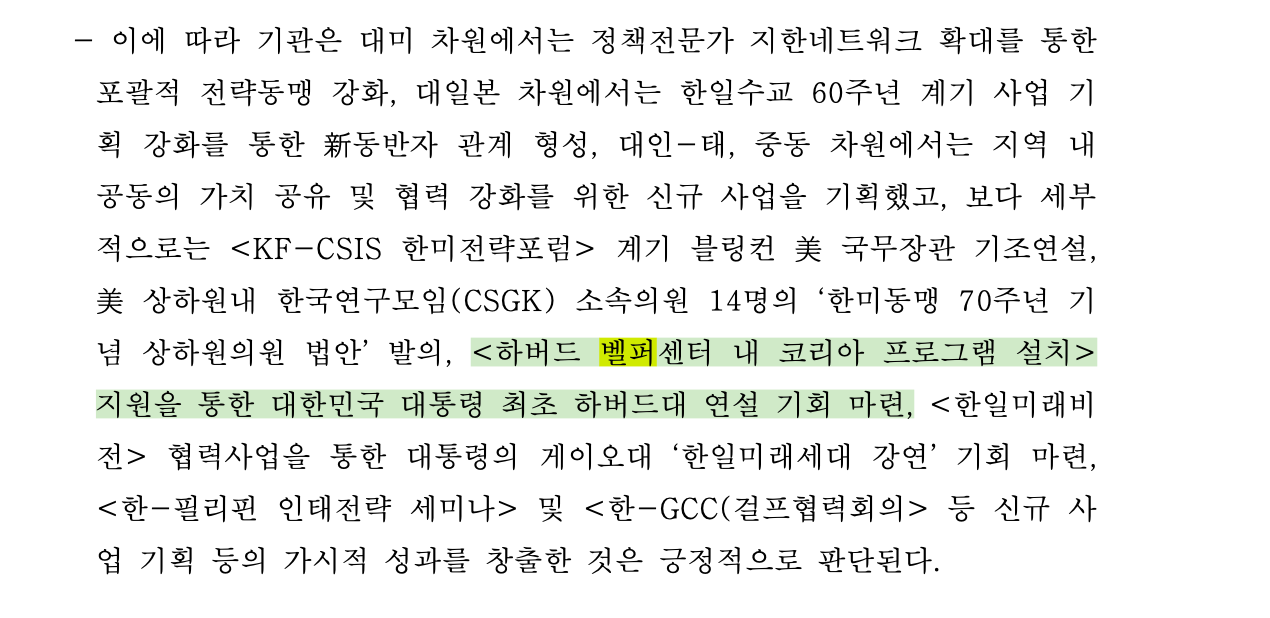 KF stated in 2023 that its support for the Belfer Center “enabled the President of the Republic of Korea to deliver a speech at Harvard University for the first time.” | Image: Screenshot of KF’s 2023 Management Evaluation report FOLLOW THE MONEY KF’s influence in Washington operates through grants and relationships that shift with South Korean electoral cycles, which the evidence suggests it uses to shape policy. By contrast, the foundation is more hands-off about its support for academic programs at U.S. universities, according to sources. At least 31 U.S. think tanks and research organizations received KF support from 2019 to 2023, annual reports analyzed by Korea Pro show, effectively representing a “whos-who” of the Korea policy community.
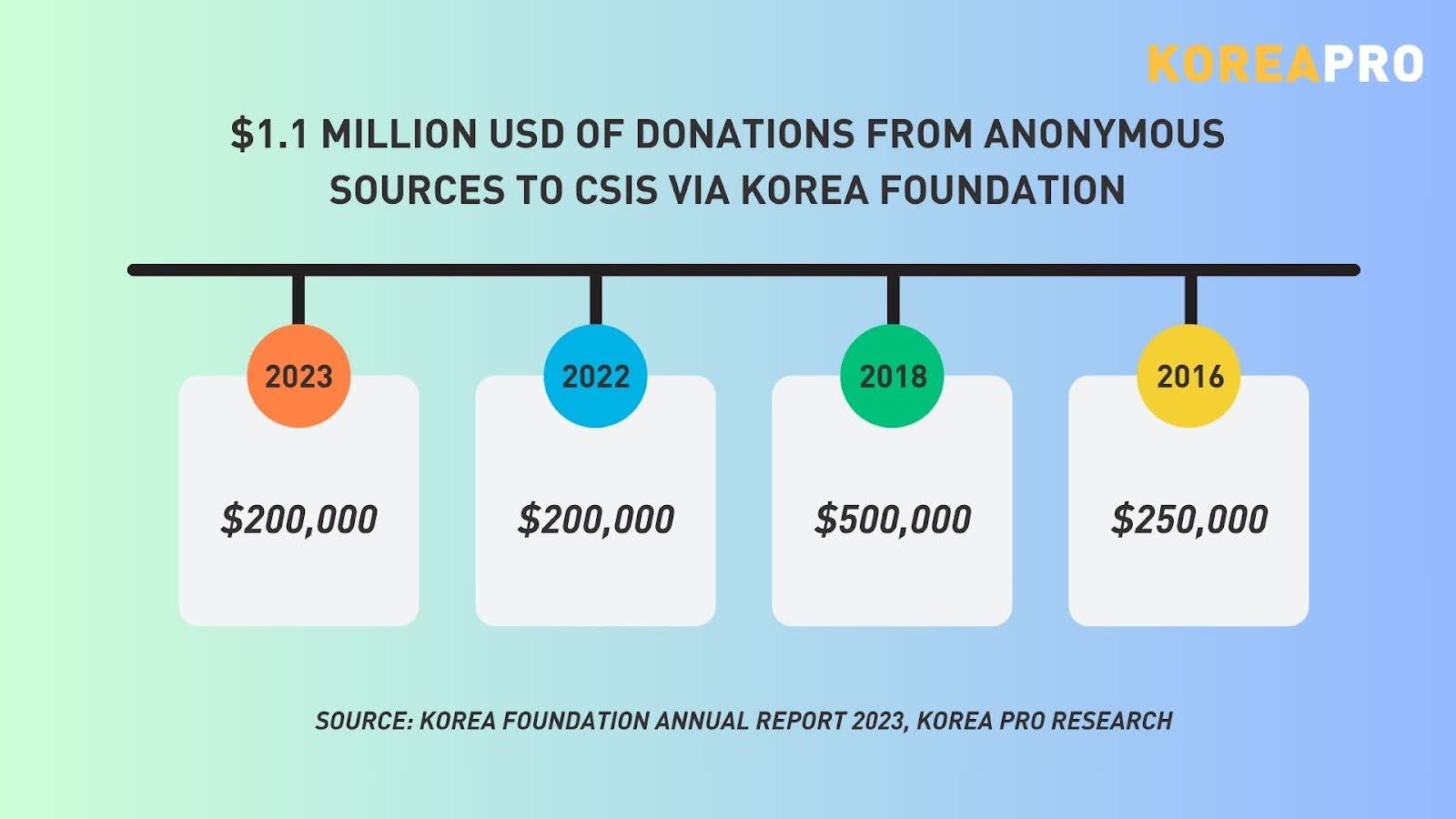
But these figures represent the very low-end estimates of actual funding. On the one hand, public disclosures by the above think tanks almost never detail specific figures, instead framing support within bands such as $250,000-499,999. Korea Pro calculated all figures using the lowest possible numbers in these ranges, meaning the figures could be much higher. Anonymous donors add another layer to KF support. The Center for Strategic and International Studies (CSIS) alone has received $1.1 million from unnamed donors since 2016 via KF, annual reports show. CSIS Korea Chair Victor Cha told Korea Pro that the center knows the “identity of all donors,” but that he didn’t know why KF annual reports list some donors as from anonymous sources. Compared to the Japan Foundation, a public diplomacy organization linked to Japan’s foreign ministry, the KF’s observable funding of the U.S. think-tank ecosystem is also dramatically higher. Korea Pro could find only $731,592 of Japan Foundation donations recorded for U.S.-based think tanks and research organizations between 2019-2023, compared to the over $9.4 million provided by KF. “The purpose of our activities is to advance Japanese studies, rather than to exert influence on policy decisions in the United States,” the Japan Foundation told Korea Pro. Joshua Stanton, a lawyer who specializes in Korea-related affairs, said he was not surprised by the wide-range of organizations that KF funds. “If you are working in the Korea space on any policy issues, the probability that your employer or your paycheck somehow depends on Korean government funding … is probably approaching 90 (percent),” he told Korea Pro. Nick Cleveland-Stout, who worked on the Quincy Institute’s Think Tank Tracker project, said the numbers showcase “South Korea’s immense influence in Washington” when compared to other nations. “From basing issues and arms sales to trade issues, the South Korean government has a number of interests in influencing U.S. policy and is using all of the tools of influence at its disposal,” he said. “The Korea Foundation, as an affiliate of the Ministry of Foreign Affairs, appears to be one such tool — and an influential one at that.”
STRINGS ATTACHED? While some recipients of KF funding reported complete independence, others described various forms of pressure to align think tank work with Seoul’s diplomatic messaging, raising concerns about KF efforts to shape U.S. policy at the direction of the ROK government. One long-time grantee told Korea Pro that, in their experience, KF program officers won’t tell grant applicants what to write but will suggest topics “that might be attractive or that might be more likely to be funded.” According to the former high-level ROK government familiar with KF processes, ROK embassies sometimes approach local think tanks or policy centers abroad with suggestions for program themes, hinting that support may be available via KF. After helping draft the funding proposal — often with embassy contacts copied on email — the embassy may then lobby KF to approve it. “That’s the pattern,” the source said. In some cases, relationships between think tanks and the embassy can grow especially close. “I had to engage with the embassy much more actively when I worked [at a major think tank with KF funding] because we did much more public-facing events,” a source who worked at a regular recipient of KF funds in Washington recalled. These connections can become problematic, another long-term KF recipient working outside of the U.S. said, referring to cases where South Korean embassies suggest what grant recipients should write in op-eds or complain when published articles don’t fit the desired narrative. “It seems like the Presidential Office has applied pressure on them to take certain actions,” the source said. A second source who worked in a KF-funded role said they had also received complaints from ROK embassy personnel after publishing an op-ed that the Seoul didn’t agree with, despite KF providing funds on the promise of research independence. Not everyone reported experiencing such pressure, however. “Our experience has been that they’ve been very hands-off,” Karl Friedhoff of the Chicago Council told Korea Pro. And Victor Cha of CSIS said that legal safeguards ensure independence and “final determination of all aspects” of KF-funded projects. While CSIS consults with partners on conferences, “the agenda, speakers and topics are ultimately CSIS’s decision and responsibility as per our MOUs,” he said. “The MOU also states that CSIS will never pre-determine the outcome of a research project or conference.” David C. Kang of the University of Southern California — who has helped operate a young scholar program with CSIS — also told Korea Pro that KF has never interfered with projects such as by trying to “influence what scholars we choose or what the content of the program is.” Despite such testimony, Cleveland-Stout of the Quincy Institute said KF’s own Annual Report language about promoting “accurate perceptions of Korea” and fostering favorable public opinion makes clear its goals. “This is a foreign government-affiliated donor saying their intent is to influence the work of a think tank in its favor, even as most think tanks deny that their foreign government donors influence their work.” Friedhoff acknowledged that KF support could discourage some larger programs from taking stances critical of the South Korean administration in power. “I can see why people might not want to cross them … if you have jobs on the line,” he said. CROSSING A LINE Korea Pro’s investigation revealed several problematic cases illustrate how KF has actively intervened to influence U.S. policy at Seoul’s apparent behest, possibly crossing a line into activity that requires FARA registration. In 2024, ahead of a public speaking engagement, the long-time grantee received a phone call from a KF representative, who allegedly suggested they “say something positive” about a recent speech by President Yoon during the event. The grantee declined. “If the Korea Foundation wants to do those sorts of things, then yes, they would have to register under FARA,” the individual said. “But my understanding is that they know that they’re not supposed to do that.” In another case, a former South Korean official was removed from a KF-funded conference after a change in the foundation’s leadership. The event organizer told the official that the newly appointed KF leader objected to their participation. “It’s not [KF leadership’s] role to pick who is being invited, who is supposed to speak at a conference,” the official said. A second source who has received KF funding independently confirmed the account. KF did not respond to Korea Pro questions about the alleged incident. Perhaps the clearest example of political retaliation came in 2005, when KF withdrew funding from the American Enterprise Institute (AEI) after scholar Nicholas Eberstadt published articles questioning U.S. military subsidies to South Korea and suggested that staff in the Roh Moo-hyun administration viewed George W. Bush’s re-election as an “emergency.” “I did become aware rather quickly that some of the critiques I had been writing hadn’t necessarily made me [the] favorite of the year in certain circles in Seoul,” Eberstadt told Korea Pro. Korean media reported that then-foreign minister Ban Ki-moon confirmed KF would no longer fund AEI or Eberstadt specifically — a decision allegedly made at the behest of the ruling party. KF declined to answer questions about whether or not protocols have changed since the decision to defund AEI. FARA OR FOUL? The key question when examining KF’s activities is whether they fall under the scope of the U.S. Foreign Agents Registration Act (FARA), with multiple experts telling Korea Pro that they believe the foundation should register as a foreign agent. FARA, enacted in 1938 to combat Nazi propaganda, requires individuals or entities acting “at the order, request or under the direction or control” of a foreign principal to register with the Justice Department if they engage in political activities within the U.S. Registration is required not just for paid lobbyists but for anyone engaging in “political activities” on behalf of a foreign principal, which is defined as including foreign governments and government-funded entities. Crucially, there need not be a written contract, payment or even a foreign government client. A mere “request” from a foreign entity for help setting up meetings with U.S. officials can trigger registration requirements, according to the international law firm Covington & Burling LLP. The law specifically covers those who intend to influence U.S. government officials or American public opinion regarding domestic or foreign policy. It also applies to those who act as political consultants, informing foreign governments about U.S. policies, if they engage in “political activities.” And while there’s an “academic exemption” that think tanks often use to avoid registration, it doesn’t apply if recipients are engaged in political activities, which can include actions that would influence the U.S. public to view the foreign government “in a positive light,” according to Covington. In 2021, the Department of Justice’s (DOJ) National Security Division allegedly wrote to KF, recommending that it consider FARA registration for work in the U.S. But the Foundation reportedly objected on the grounds that it is an “independent organization … engaged in cultural and academic exchanges exempt from FARA.” The DOJ’s FARA unit and KF declined to comment when contacted by Korea Pro, but several experts indicated that they agreed with the DOJ’s reported recommendation. “A foreign foundation with ties to a government that advocates for creating ‘a supportive atmosphere for the foreign policy measures of the Korean government’… It seems pretty clear that the Korea Foundation is the agent of the Korean government,” a former DOJ lawyer specializing on FARA issues told Korea Pro, speaking on condition of anonymity. The expert added that, as a foreign agent operating in the U.S., KF’s meetings and donations are reportable “even if you don’t think that they’re doing political activity, just giving money.” The lawyer Joshua Stanton echoed this point. “I have long felt that the Korea Foundation falls within the spirit, if not not necessarily the letter, of the FARA,” he said. “When you set up a [foundation] and you fund it indirectly with government funds, and then that entity then disperses funds, both through other non-governmental entities and then directly to people who have influence on policy, that does suggest that they’re doing something indirectly that would be wrong or they think would look wrong if they did it directly.” Ben Freeman of the Quincy Institute, which tracks foreign funding of think tanks, emphasized that KF has given millions of dollars to U.S. think tanks that have produced “quite favorable research related to South Korea.” “That at the very least begs the question of whether or not its grantees should be registered under FARA.” Eberstadt of the AEI argued that it would be “better safe than sorry” for KF to register under FARA. “I don’t think there would be anything sinister or shocking about that,” he said. 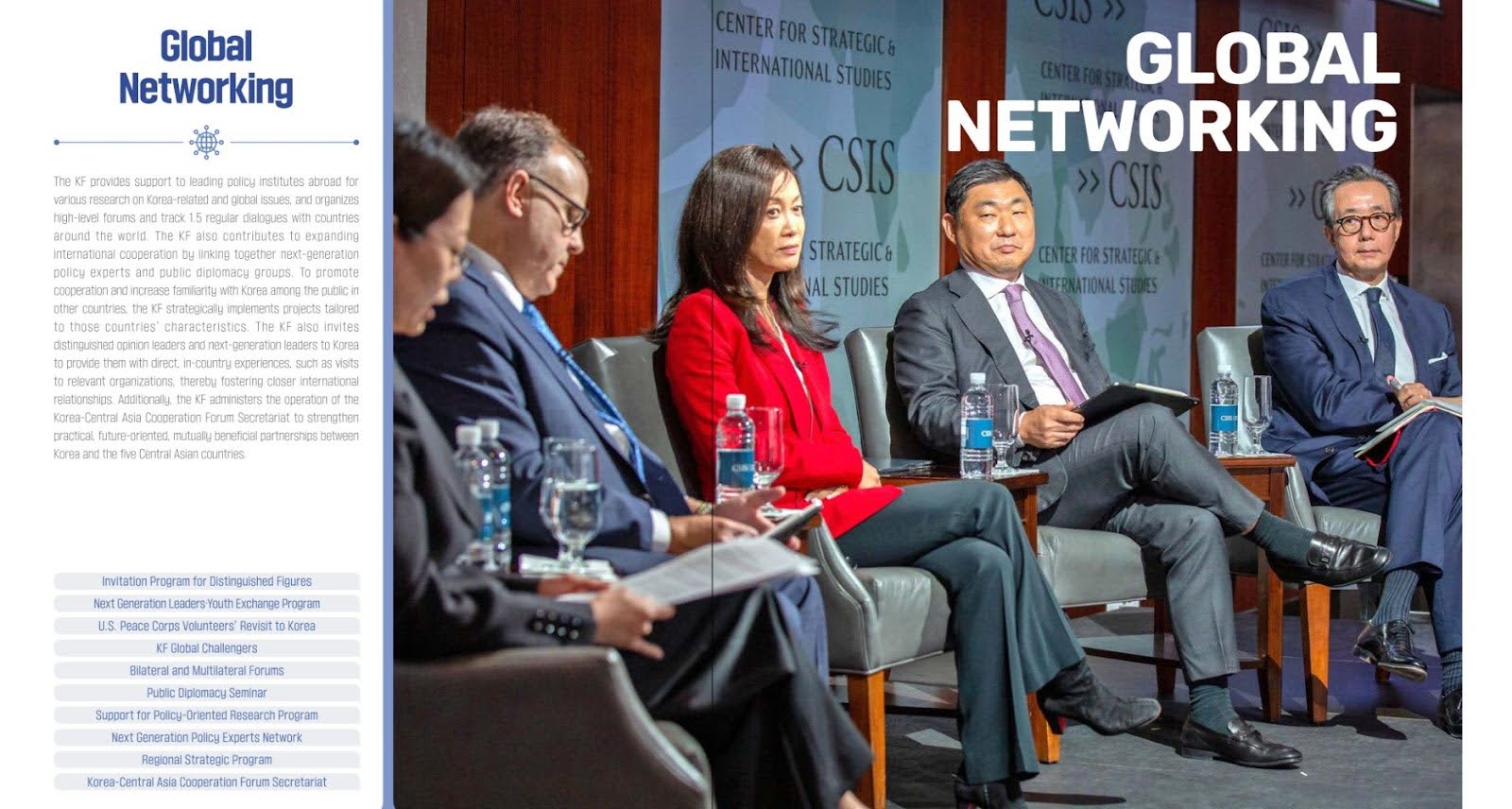 A screenshot from a Korea Foundation annual report, 2023 FARA SENSITIVITIES Despite KF’s insistence that it is “not a government entity,” Korea Pro’s investigation suggests the foundation is aware that its activities could be interpreted as violating FARA rules, and that it is keen to avoid the stigma of registering as a foreign agent. Last July, U.S. federal prosecutors accused prominent Korea expert Sue Mi Terry, a former CIA analyst and White House official, of working for ROK spies in exchange for luxury goods and expensive dinners, charging her with refusing to register as a foreign agent under FARA. The case, which is still ongoing, stunned Beltway insiders and prompted soul searching about the extent of South Korean influence. It also allegedly sent KF into crisis mode. “Everyone was freaking out because we were worried that it might impact what we do in public diplomacy in Washington, D.C. because they might be thinking that we’re doing lobbying,” a former KF staffer told Korea Pro. The source said KF canceled meetings and “tried to erase our name in certain events even though the event was funded by the Korea Foundation. We tried to go silent.” According to the former staffer, KF is sensitive about FARA because registering as a foreign agent would require the foundation to report “every single meeting or every money or budget to the U.S. government.” FARA registration requires semiannual filings to the DOJ about many activities within the U.S. KF’s reluctance to register may stem from more than legal caution, Freeman of the Quincy Institute explained. “There can also be a stigma associated with registering under FARA in that you are then officially labeled a ‘foreign agent,’ which can negatively impact things like fundraising, press work and Congressional relations.” The lawyer Stanton suggested that think tanks “may fear embarrassment” from working with FARA-registered organizations, but he suggested that is the “price you pay” for receiving resources from a foreign government. In at least one case, a recipient of KF funding voluntarily registered under FARA. Citing an “an abundance of caution,” Center for International Policy for a peace advocacy project said it did not believe its work for a peace advocacy project constituted political activity but that it chose to do so due to recent DOJ interpretations about what requires registration. AT A CROSSROADS For over three decades, KF has been at the center of South Korean public diplomacy in the U.S. and beyond, funding cultural programs that supporters say have enriched American understanding of a crucial ally. “I like the fact that there are entities in Washington trying to contribute to ideas. That’s a productive and healthy conversation,” a think tank insider told Korea Pro. Karl Friedhoff of the Chicago Council agreed that KF’s role is “overall positive” and warned that reduced funding would mean “much less work being done overall on Korea.” Yet KF’s funding for policy research and coordination with South Korean embassies, often in response to the political winds in Seoul, appears to take it into territory that U.S. transparency laws were designed to illuminate. Critics of KF’s activities told Korea Pro that the question is not whether South Korea should refrain from public diplomacy, something every major nation does, but how it should carry out its work. Joshua Stanton said the Korea Economic Institute, which is FARA-registered, “writes a lot of really good, objective and useful information.” Registration, he emphasized, need not compromise credibility but only increase transparency. Eberstadt concurred: “Much more damaging to South Korea’s national interest would be the sort of lack of confidence that would come from suspicions or unfounded suspicions that there was some sort of nefarious hidden hand here.” The former DOJ lawyer specializing in FARA issues acknowledged that registering could impact how think tanks work with KF. “Maybe they (would) make different decisions, maybe they make the same decisions,” they said. “But it would certainly, as someone who consumes their programming, be a relevant fact.” Daniel Auble, director of the Foreign Lobby Watch program at OpenSecrets.org, called it “essential” for KF to make FARA disclosures: “Getting a full account of the scope of their spending and who their lobbying targeted is important to hold them accountable.” Going forward, KF could find it harder to avoid registering as a foreign agent amid intensifying scrutiny of influence operations — from Russian election interference and Chinese academic programs to fears about foreign contractors working for the U.S. government. And as the Sue Mi Terry case showed, not even U.S. allies can count on being exempt from democratic expectations of transparency. “If you’re a scholar and you are receiving a significant amount of funding or direction or control from a foreign government, you really owe that to the people who work with you, to your employer, to your colleagues, to your friends,” Stanton said. “I wish for a day when we will really reassert the independence of our commentary.” Edited by Bryan Betts Editor’s note: Korea Risk Group, the publisher of Korea Pro, previously applied unsuccessfully for a Korea Foundation grant. This report was produced independently, without input or influence from the Korea Foundation or other organizations. © Korea Risk Group. All rights reserved. 
|

November 12, 2026Nov 12, 2026

Never be sidelined again
 SHARE
 COPY LINK
 X
 MASTODON