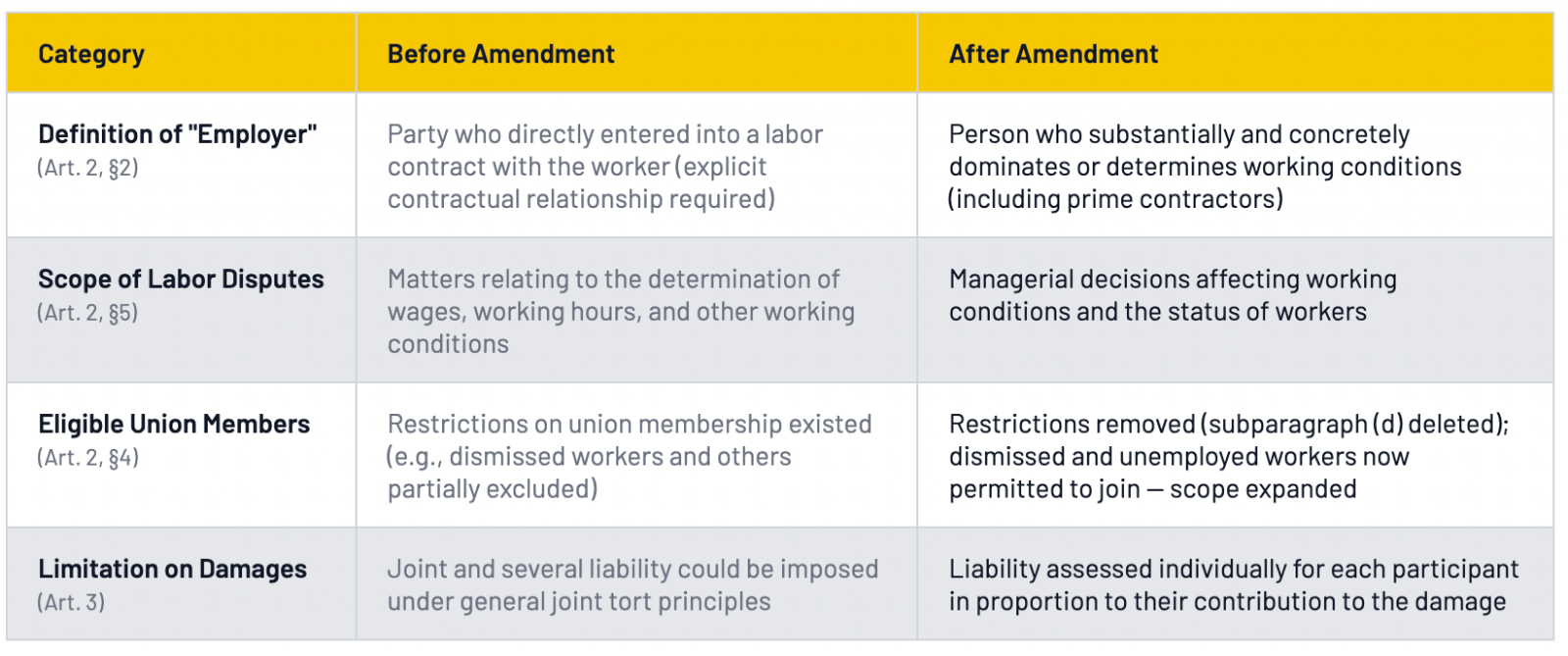
Analysis Early Yellow Envelope rulings reveal fuzzy definitions of ‘substantive control’Weeks in, rulings show mixed signals on employer status thresholds and when unions can bargain in separate units  South Korea’s regional labor commissions have issued decisions on dozens of Yellow Envelope Act employer status cases since the law took effect seven weeks ago. When the amended labor union law took effect on March 10, one of the things it did was to upend the assumption that only the company that directly signed the employment contract had bargaining obligations, and that managerial decisions such as layoffs were beyond the scope of what workers could seek to negotiate. Under the revised law, a party that substantially and concretely dominates or determines the working conditions of subcontracted workers can now be recognized as their “de facto” employer (실질적 사용자) even without a direct employment relationship. However, it is difficult to ascertain where that threshold actually sits. The labor ministry issued a 50-page guideline before the law took effect, attempting to define what “substantial and concrete” control means in practice. But as the guideline itself acknowledges, key thresholds remain open to interpretation. Regional labor commission (지방노동위원회, 지노위) rulings have been accumulating, and while the pattern is not consistent across industries, the decisions handed down so far offer the most concrete signal yet of where the lines are being drawn. Taken together, these early rulings indicate that employer status is being defined case by case, with initial decisions already shaping how broadly bargaining obligations may extend beyond direct employment relationships.
PUBLIC SECTOR SETS THE TONE The first ruling came on April 2, when the South Chungcheong Regional Labor Commission ruled in favor of four subcontractor unions representing janitorial and security staff at public research and financial institutions — the Korea Atomic Energy Research Institute, the Korea Institute of Nuclear Safety, the Korea Asset Management Corporation (KAMCO) and the Korea Research Institute of Standards and Science. The unions, affiliated with the Korean Confederation of Trade Unions (KCTU)-linked Public Solidarity Labor Union, had filed correction orders after the four institutions refused to post the legally required seven-day public notice of bargaining demands — a procedural obligation that begins once a subcontractor union files a bargaining request under the amended law. After reviewing service contracts, work logs and task specifications, the commission concluded that the institutions in question exercised “substantive” influence over subcontracted workers’ “safety management” and “staffing allocation” — enough to qualify as a de facto employer under the revised framework. The ruling marked the first application of the “substantive control” standard, and the practical significance was immediate. All four institutions were ordered to post the bargaining notice and face potential criminal liability under unfair labor practice provisions if they refused to engage. Three of the four subsequently signaled willingness to bargain, effectively setting an initial benchmark for how “substantive control” is likely to be interpreted. Five days later, the Seoul Regional Labor Commission extended the same logic to Korea Airports Corporation, ruling that it exercised substantive control over the overtime work systems of employees at its subsidiaries — determining when overtime was authorized and how it was structured — and recognized the corporation as a de facto employer for those conditions. It was the first ruling to apply employer status within a parent-subsidiary relationship at a public enterprise.  Workers protest to demand that the government amend Articles 2 and 3 of South Korea’s Trade Union and Labor Relations Adjustment Act, July 11, 2024 | Image: Korean Confederation of Trade Unions via Facebook PRIVATE SECTOR FOLLOWS: FASTER THAN EXPECTED On the same day as the Korea Airports Corporation ruling, the Seoul Regional Labor Commission issued the first private sector employer status finding under the amended law. The case involved two universities — Induk University and Sungkonghoe University. The Public Transport and Social Services Union had filed bargaining requests covering five agenda items — labor safety, working environment, welfare benefits, wages and working hours — after both institutions refused to post the required public notice, denying they qualified as employers. The commission ruled against the universities, concluding that both institutions structurally controlled the working hours of their facility management subcontractors and exercised substantive influence over working environment conditions, including “rest facilities.” The institutions were ordered to post bargaining notices and engage with the union. On April 16, the Incheon Regional Labor Commission ruled that Hyundai Steel qualified as a de facto employer for workers at its affiliated subcontracting companies. The commission approved separate bargaining units (교섭단위 분리) across three units — one affiliated with the Federation of Korean Metalworkers’ Trade Unions, one with the Korean Metal Workers’ Union and one independent union. Hyundai Steel had previously resisted bargaining demands despite a lower court finding of “illegal dispatch” (불법파견), citing a pending Supreme Court ruling. 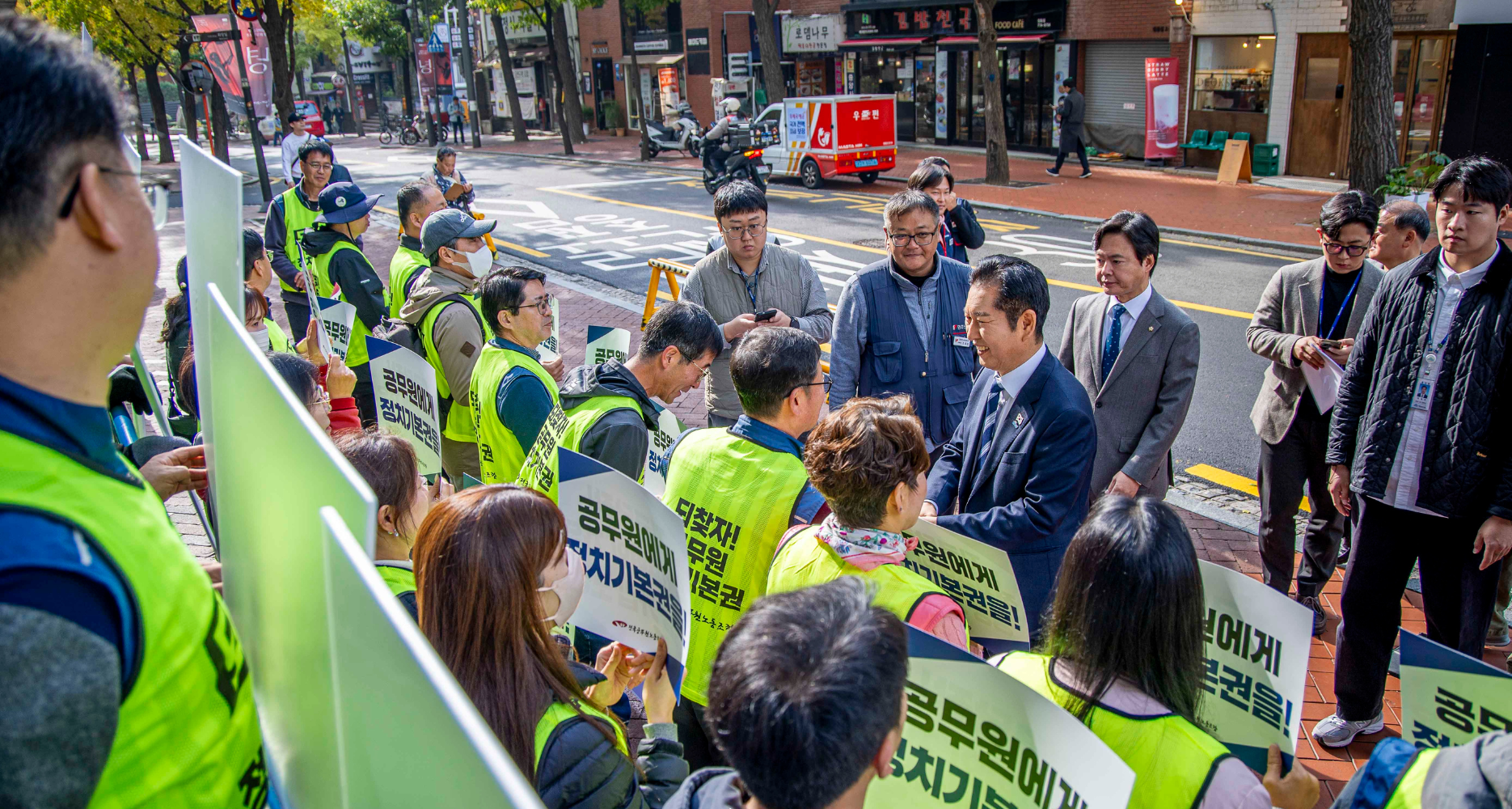 Ruling Democratic Party leader Jung Chung-rae meets with members of the Korean Confederation of Trade Unions, Nov. 6, 2025 | Image: Democratic Party of Korea SCOPE PRECEDENT On the same day, the South Gyeongsang Regional Labor Commission extended employer status further than many had anticipated. It ruled that Hanwha Ocean was a de facto employer not only for its direct shipbuilding subcontractors, but also for workers employed by Welliv, a food service and facilities management company operating inside Hanwha Ocean’s premises. The commission found that Hanwha Ocean determined Welliv workers’ shuttle routes and meal service schedules, and held disposal rights (처분권) over the facilities where they worked. Hanwha Ocean had posted the required bargaining notice for its shipbuilding subcontractors but excluded Welliv, a distinction the commission rejected. It was ordered to repost the notice within five days to include Welliv’s union. The Welliv ruling was notable for what it implied about scope. Employer status had now been recognized not just for workers on the production floor, but for those performing peripheral services inside a primary contractor’s facilities. This suggests that the boundary of “substantive control” extends beyond core production activities into auxiliary operations embedded within a firm’s broader operational structure.  Park Se-joong, director of Occupational Safety and Health at the National Construction Workers’ Union, pours cold water from a safety helmet over his head during a protest demanding the implementation of safety measures into legislation in front of the Yongsan Presidential Office, Aug. 2, 2023 | Image: National Construction Workers’ Union UNION LOSSES There are also cases where employer status or bargaining unit separation have been dismissed. The first rejection came on April 10 when the South Jeolla Regional Labor Commission dismissed a petition filed by the FKTU-affiliated Korean Tower Crane Operators Union against two construction firms — Jungheung Construction and Jungheung E&C. The commission found that Tower Crane operators work with significant independence as the primary contractors do not meaningfully determine their wages or dictate how they perform their work. That fell short of the “substantive and concrete” control standard required under the amended law. Although the union has said it plans to file for review with the Central Labor Commission, the initial rejections indicate that where worker autonomy remains high and contractor involvement is indirect, the threshold for employer status may not be met. 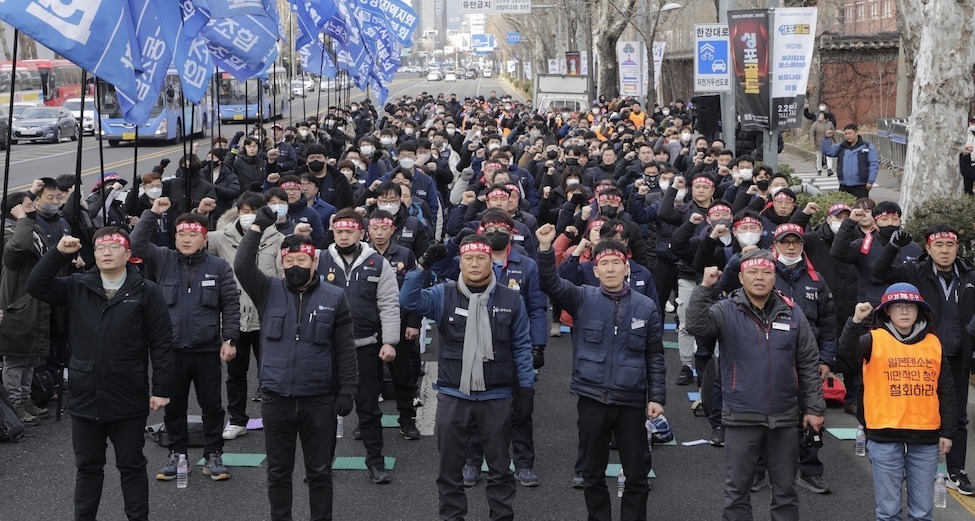 Korean Metal Workers’ Union members protest against the Yoon Suk Yeol administration’s labor policies, Feb. 16, 2023 | Image: Facebook THE BARGAINING UNIT QUESTION Once employer status is established, the next challenge is to determine how many separate bargaining channels a primary contractor must engage with. Notably, the amended law’s enforcement decree allows subcontractor unions to request independent bargaining units based on differences in common interests and working conditions. For firms, the stakes of fragmentation are significant. Each separate bargaining unit can time its dispute actions independently, meaning a company could face rolling strikes rather than a single consolidated negotiation. For unions, this creates additional leverage by enabling disputes to be staged over time rather than resolved collectively. The results so far have been mixed. The North Gyeongsang Regional Labor Commission granted separation requests from two KCTU-affiliated unions alongside an existing FKTU-affiliated subcontractor union. In practice, this means that firms like POSCO must now bargain separately with three subcontractor unions in addition to its in-house union, bringing its total bargaining obligations to four. Similar separation requests were granted at Korea Electric Power Corporation, Dongheui Auto and three financial institutions — KB Kookmin Bank, Hana Bank and KB Kookmin Card — where subcontracted call center unions successfully argued their functions were distinct enough to warrant independent units. Not all separation requests succeeded. The Ulsan Regional Labor Commission rejected requests filed by the National Plant Construction Union against SK Energy, S-Oil and Korea Zinc, finding no meaningful differences between the unions involved and noting that separation could widen “labor condition” (근로조건) disparities rather than address them. At Coupang Logistics Services (CLS), the Seoul commission rejected the KCTU-affiliated delivery union’s bid for a separate unit from the FKTU union already present, finding no significant differences in working conditions between the two. Coupang had accepted employer status the day the amended law came into effect and was first to accept bargaining demands, but resisted being required to bargain with each union independently. On April 24, Samsung C&T, Hanwha and GS Engineering and Construction all had separation requests denied, with the Seoul commission finding that the breadth of their operations did not justify fragmented bargaining, although employer status for all three was confirmed. For firms, these rulings indicate that the risk of the Yellow Envelope Act does not come only from being recognized as the de facto employer, but also from multiple unions being allowed to bargain separately. In practice, this means that corporate-labor relations management will become more challenging as additional variables can lead to negotiation collapses as well as strikes. 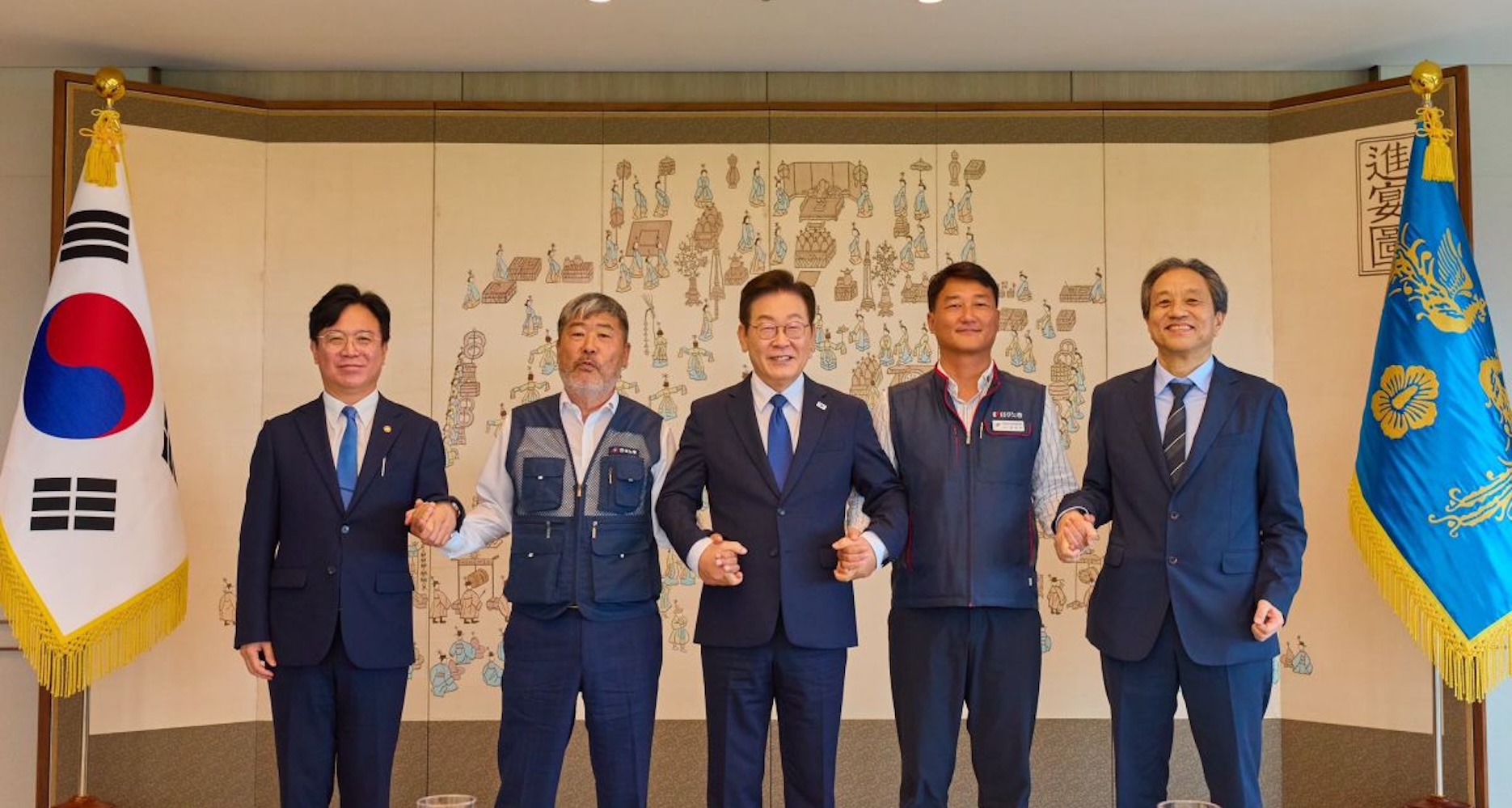 President Lee Jae Myung meets labor union leaders to discuss issues including the 4.5-day work week and retirement age, Sept. 4, 2025 | Image: ROK Presidential Office STRATEGIC WITHDRAWAL Before many cases could be decided, unions began withdrawing them. As of early April, 71 of 159 correction order filings had been withdrawn, along with 27 of 114 bargaining unit separation requests. The largest withdrawal came from the Korean Tower Crane Operators Union, which had filed against 93 primary contractors including Daewoo Construction and POSCO E&C, then withdrew 49 of those filings on April 6. The union’s chairman cited insufficient evidence and the risk that adverse rulings could set unfavorable precedent. That calculation proved well-founded, as the Jungheung rejection came days later. The Department Store and Duty-Free Retail Service Workers Union withdrew 12 of 17 filings amid an ongoing administrative court appeal related to employer status recognition. Other unions followed similar patterns where favorable legal outcomes were uncertain. For instance, the public care worker union withdrew all 16 of its filings. These withdrawals suggest that both unions and firms are treating early rulings as precedent-setting rather than isolated decisions. 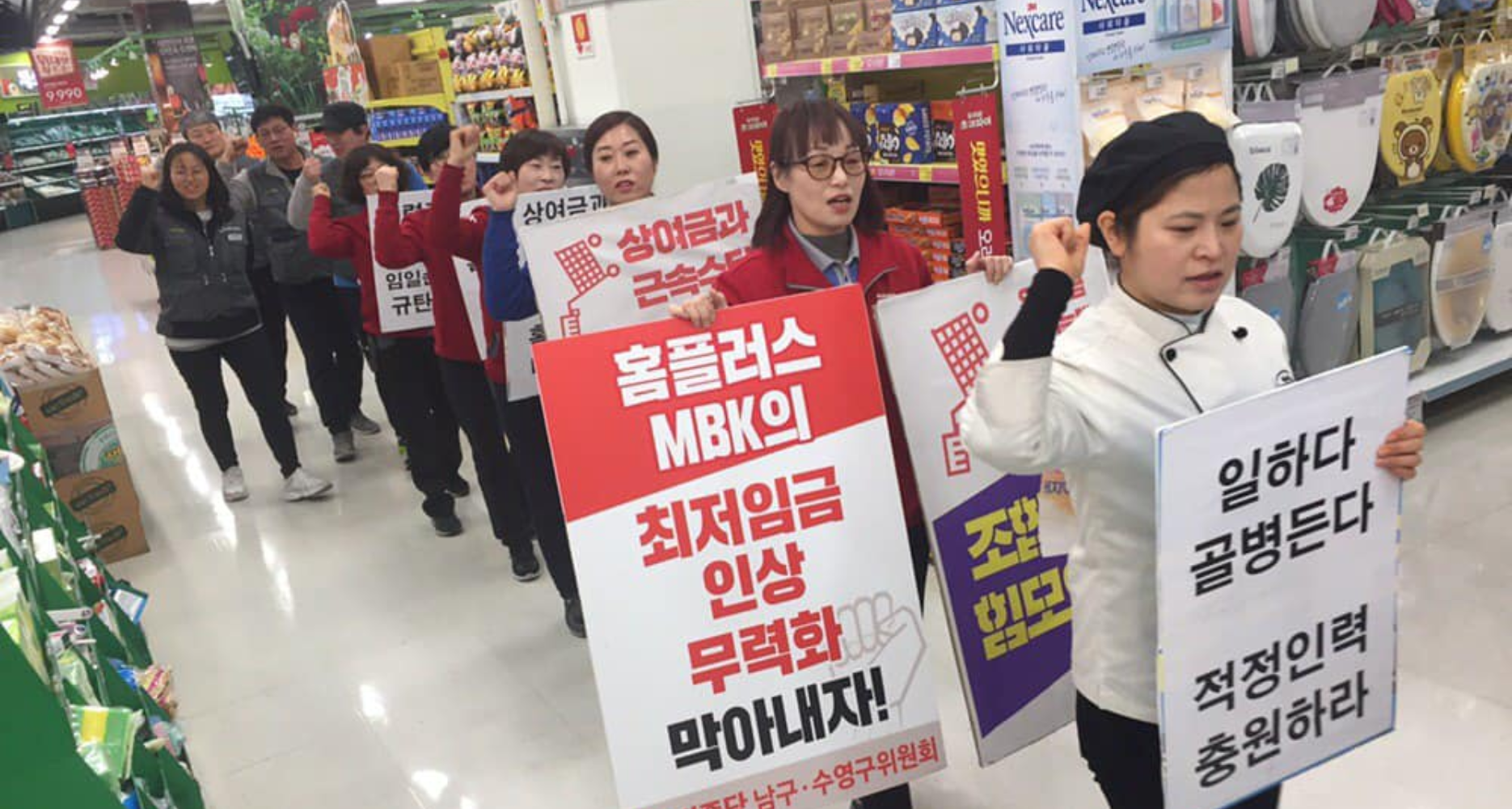 Homeplus employees protest to demand higher wages and additional hiring, Jan. 30, 2019 | Image: Homeplus Branch of the Mart Industry Labor Union via Facebook THE NEXT BATTLEGROUND: WAGES Most employer status findings so far have rested on safety management and staffing allocation. Attention is now turning to wages even though the labor ministry’s guideline states that wages are “generated and determined between the contractual employer and the relevant worker.” However, the Korean Metal Workers’ Union has placed wages on the bargaining agenda with primary contractors in the construction sector, arguing that structural control over safety and workforce and operations feeds into wages. So far, no labor commission has ruled directly on whether a primary contractor qualifies as a de facto employer for wage bargaining purposes. If recognized, this would extend employer obligations from working conditions into compensation itself. The ongoing dispute between BGF Retail — the parent company that owns the CU convenience store chain — and the cargo union offers a preview. The union went on strike on April 5, and blocked access to four logistics centers, demanding freight rate increases and direct bargaining. BGF Retail maintains it is not a direct employer, given the multi-layered contract structure between it and the drivers. How that case is resolved will serve as an early signal for wage-related employer status claims.  Progressive lawmakers and activists call for the “Yellow Envelope Bill (노란봉투법)” to be passed at the National Assembly, April 13, 2023 | Image: Justice Party WHAT CAN BE DEDUCED SO FAR Several patterns have emerged. Where primary contractors are involved in safety management and staffing allocation, employer status is more likely to be recognized. Where workers operate with significant autonomy, as with tower crane operators, status has been denied. The principle that employer status is issue-specific rather than absolute has also been confirmed. Uncertainty remains substantial. Similar cases have produced different outcomes across regions, and ruling documents are not immediately available for review. Several Central Labor Commission reviews are already in progress, and administrative litigation is underway in parallel. Notably, primary contractors that refuse to bargain after employer status is confirmed face potential criminal liability under unfair labor practice provisions, including imprisonment or fines. Of the variables ahead, how higher-level bodies interpret and standardize these early rulings will likely determine whether a consistent framework emerges or whether case-by-case variation persists. Edited by John Lee © Korea Risk Group. All rights reserved. 
|

October 24, 2026Oct 24, 2026

Never be sidelined again
 SHARE
SHARE COPY LINK
 X
X MASTODON