  
Opinion South Korea’s hostility to LGBT issues is a failure to uphold basic human rightsThe ROK is out of step with its Western peers even Asian neighbors and must reflect on how it treats sexual minorities  South Korea’s head-in-the-sand approach to LGBT rights is a stark human rights failure. It is glaringly inconsistent with President Yoon Suk-yeol’s commitment to human rights globally and out of step with its Western peers. Now, even its Asian neighbors are leaving it behind. During my five years in South Korea as an ambassador, I encountered many LGBT Koreans: men and women, young and old, business people, diplomats, professors and homemakers. Nearly all felt forced to hide their sexuality, their partners and their true selves. Virtually none felt able to come out to their parents or at their workplaces. They managed the social and psychological stress with varying degrees of success. Typical comments I heard were: “My parents will not understand,” “My family does not believe LGBT people exist in Korea,” and “It is impossible to have a successful career and be out in Korea.” I recall one young student at an event where we linked Korean and New Zealand high school students in virtual English discussions. She courageously spoke up about her personal journey of diversity, saying she was inspired by her interaction with foreign students to overcome her fears about ostracism in her own society. For a long time, many Asian countries dismissed LGBT rights as a liberal, Western fad that did not apply to Asia, whether traditionally Buddhist, Muslim or Confucian like South Korea. Yet in the last five years, there has been a wave of advances in LGBT rights across much of Asia, adding pressure on South Korea to uphold the human rights values it preaches. PROGRESS IN ASIA Taiwan became the first jurisdiction in Asia to legislate same-sex marriage in 2019. In Nov. 2023, Nepal became the first country in Asia to register a same-sex marriage. A month later, Thailand’s parliament began debate on a same-sex marriage bill. LGBT rights also saw progress in India in Oct. 2023. Although the country’s Supreme Court declined to legalize same-sex marriage outright, it came as close as it felt able by affirming the constitutional rights of LGBT citizens and called on parliament and state legislatures to enact laws to “meet challenges” the LGBT community faces. That ruling represents a rapid change in a nation that only decriminalized homosexuality in 2017, ridding the country of an egregious relic of its colonial history under the British. Similarly, Hong Kong’s Court of Final Appeal told the government in Sept. 2023 that it had a constitutional duty to provide a legal framework for same-sex relationships within two years. Most recently, the Sapporo High Court declared on March 14 that Japan’s prohibition of same-sex marriage was unconstitutional on three separate counts and urged the government to take urgent legislative action. The judgment was the first by a high court in response to six parallel lawsuits making their way through Japan’s courts. Six of seven rulings to date have agreed that the current situation is problematic under the country’s constitution. Japan’s Supreme Court will likely issue a definitive ruling next year. If the court agrees that Japan’s prohibition of same-sex marriage is unconstitutional, it would force the Diet to take legislative action. 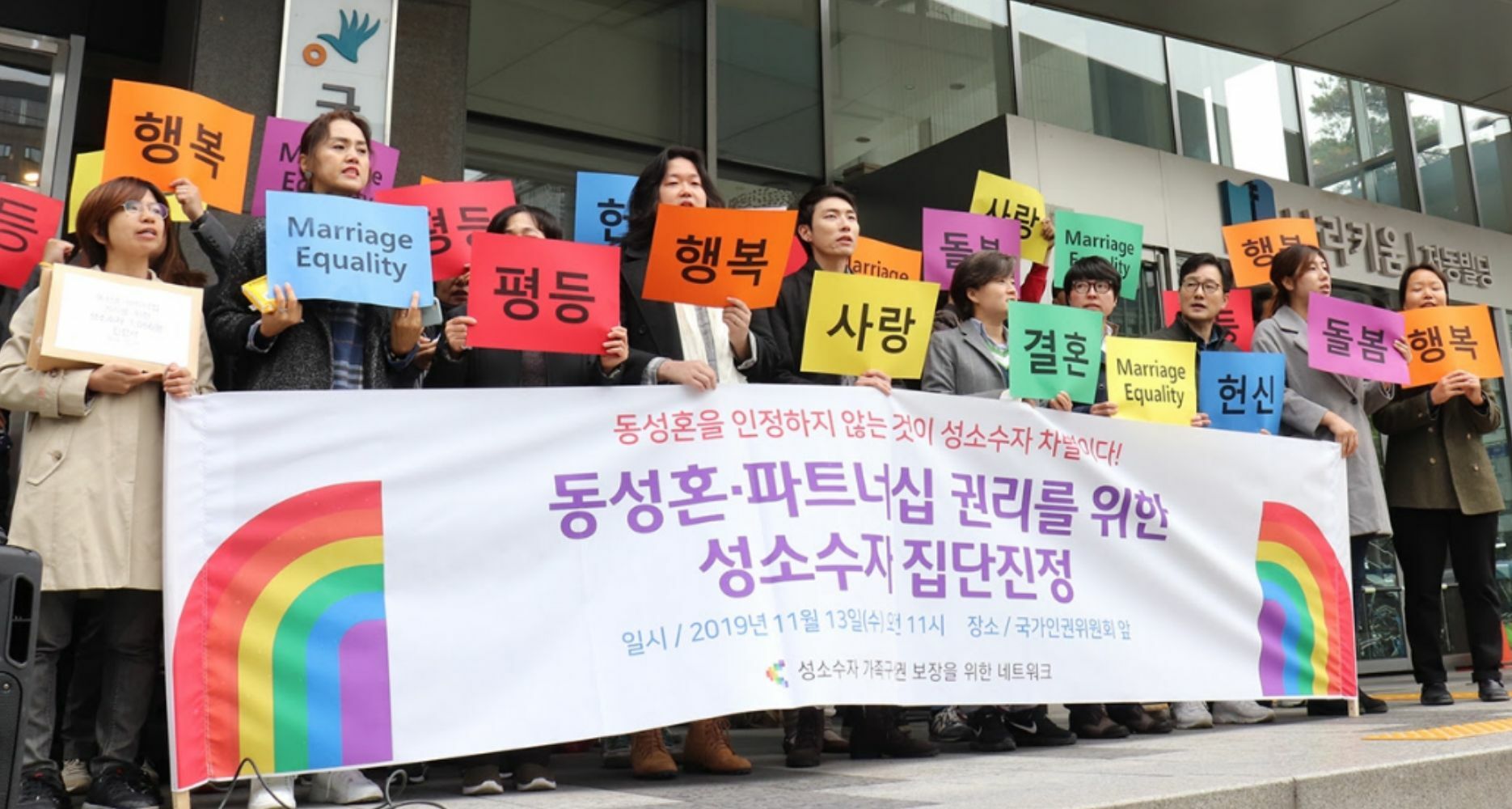 Members of the South Korean LGBT community welcome the Human Rights Commission’s recommendation to enact legislation to guarantee the right of sexual minorities to form families, April 2022 | Image: Marriage for All Korea SMALL STEPS Horim Yi and Minhee Ryu, two campaign leaders of Marriage for All Korea — an advocacy group — visited Japan to hear the Sapporo High Court’s judgment as they believe that South Korean courts will study it closely. “Given the similarities in our two countries’ laws, it is likely to have a big influence in South Korea,” Yi told Korea Pro. Progress on LGBT issues has been meager in South Korea. The National Assembly has long held up a comprehensive non-discrimination bill, with both major parties opposing its inclusion of LGBT rights. In the last year, minority parties and individuals submitted bills proposing both same-sex marriage and (separately) same-sex partnership. While the committee at least discussed the latter, the former did not even make it that far. However, there have been some small victories. The Seoul High Court ruled in Feb. 2023 that the government’s health insurance system could not discriminate against a same-sex couple — the first time a Korean court recognized the need to protect same-sex couples. The South Korean Supreme Court also ruled in November that transgender parents with children under 19 can now legally change their gender. Further, Marriage for All Korea launched a campaign last June that aims to humanize the issue of same-sex marriage by telling individual and family stories through videos and national advertisements. “Our objective is to win people’s hearts and minds by showing the experiences of same-sex couples in their daily lives in Korea and how their families, friends and colleagues support those relationships,” Yi said. ENFORCING THE LAW South Korean LGBT rights activists are aware that the courts have led the way in other parts of Asia, forcing legislators to take action simply by enforcing existing constitutional laws. Yi and Ryu believe that South Korea will likely follow the same path. Marriage for All Korea plans to follow a similar approach to their international counterparts in launching legal action in several locations in October, arguing that the ban on same-sex marriage is unconstitutional. They aim to sign up 10 to 15 same-sex couples as plaintiffs. When the group first considered this option 10 years ago, they struggled to find volunteers. This time, however, Yi says there has been no shortage — instead, they will need to limit the number of applicants. They are optimistic about their chances, as Ryu maintains that the ROK Constitution specifies, even more clearly than Japan’s, that marriage is a basic right. “The Constitution says that men and women should be treated equally in marriage and family life. It is clear that cannot be restricted,” Ryu stated. Yi agrees that there are no legal grounds for opposing same-sex marriage but adds “the main obstacle will be tradition and history.” However, even tradition and history are not the impenetrable barriers that they once were. For instance, a poll from Feb. 2023 showed that 72% of Japanese supported legalizing same-sex marriage, up from 65% in 2021 and a higher number than in many European countries. Similarly, public opinion is changing in South Korea. A Gallup Korea survey from May 2021 showed that 81% of Koreans believe that it is not justifiable for employers to terminate workers on the basis of their sexual orientation. In May 2023, 40% of the Korean public supported marriage equality. While that number is still a minority, it is considerably higher than in 2017. “These numbers show that the Korean community is really changing,” Yi told Korea Pro. “Many people are now vocal and prepared to be visible in their workplaces and to their families. The community is ready for change now.” 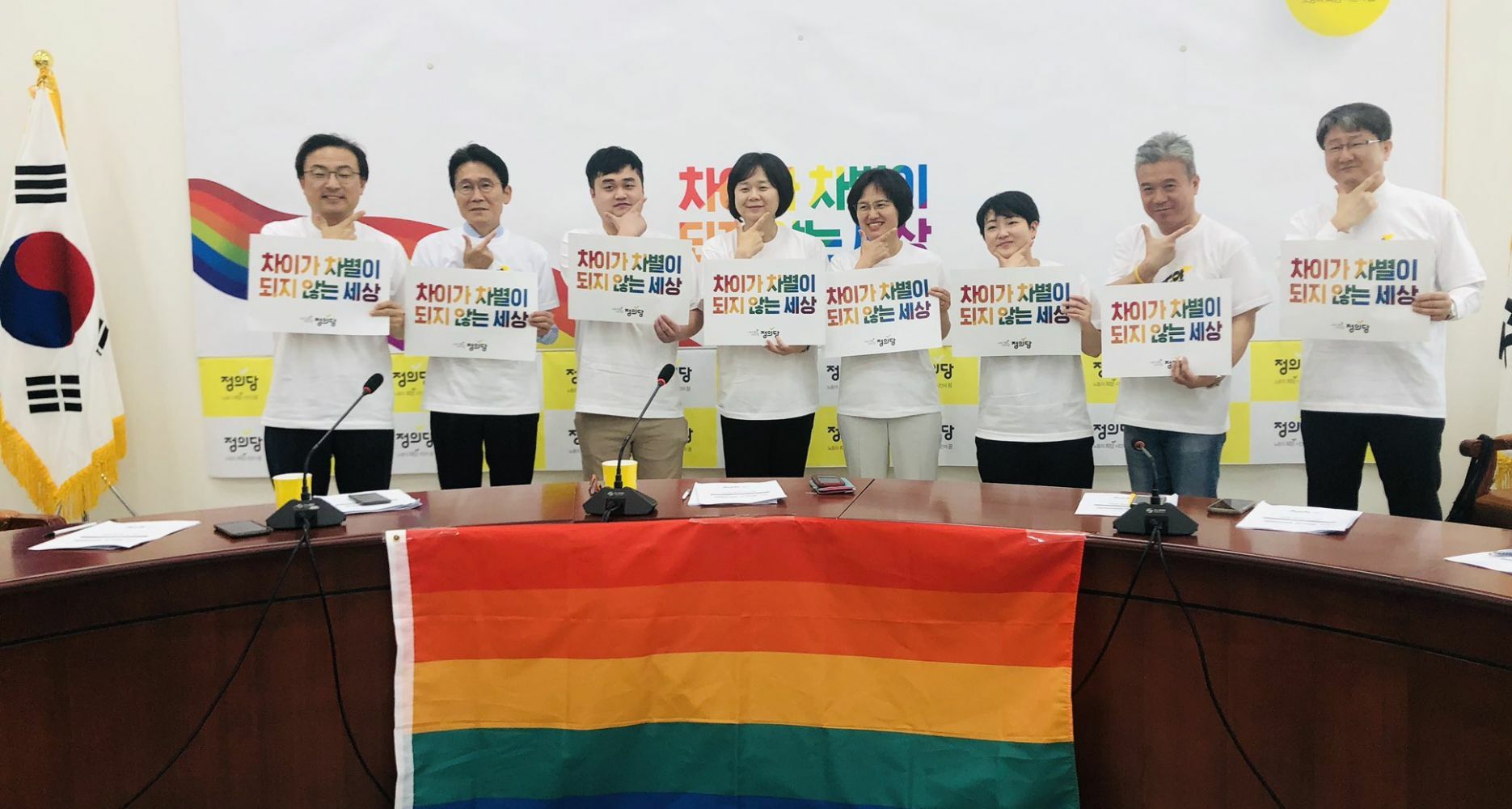 Members of the Justice Party advocating for LGBT rights and equality in 2019 | Image: Justice Party LGBT Committee via Twitter INTERNATIONAL PRESSURE While the legal approach might offer a way forward for South Korea’s LGBT community, political challenges remain. Facing strong opposition from Christian groups, both of South Korea’s two major parties have repeatedly stated that they must seek “social consensus” to move forward. However, Yi and Ryu hope that the country’s leaders will look around at what is happening in other Asian countries and realize how much South Korea is lagging behind. “It’s a big wake-up call for Koreans. We need to think about what kind of country we want to be at home and how people in other countries perceive us,” Ryu said. South Korea and Japan consistently rank at the bottom of the Organization for Co-operation and Economic Development’s measures of gender equality and minority rights. South Korea will stay even further behind if the Japanese Supreme Court rules that same-sex marriage is unconstitutional next year. Meanwhile, South Korea’s democratic partners are increasingly raising concerns about gender issues. When Japan hosted the G7 summit in Hiroshima last year, its ministers were embarrassed to find themselves singled out for criticism for their country’s lack of action on gender issues. Japan did not help its case by being the only country to dispatch a man to the G7 ministerial meeting on gender equality. In the face of international pressure, Japan’s politicians passed a law promoting the “understanding” of LGBT issues last year. While the law itself was largely window-dressing, it showed the pressure Japan faces from its peers. In South Korea, although President Yoon Suk-yeol has committed his government to human rights and liberal democratic values under his slogan of a global pivotal state, the country has failed to put its verbal commitments into practice domestically. Like Japan, South Korea will likely come under increasing international pressure through frameworks like the U.N., G7 and NGOs to improve its woeful record. At a minimum, outsiders will expect Seoul to uphold at home the values it advocates internationally. It is shameful — and telling — that the regional country South Korea most resembles on this issue is China, where Xi Jinping’s regime has cracked down on any form of divergent domestic “political” views and suppressed debates on LGBT issues. Courts in the region are aligned in pointing out that they are not inventing new rights for minorities; they are merely enforcing those that are already embedded in their existing constitutions, including South Korea’s. This argument is aligned with Yi and Ryu’s demands. They are not asking for a radical change but simply the recognition that fundamental human rights apply to them, too. Without a change of course, South Korea’s liberal credentials will come under greater pressure. But beyond just thinking about its international brand, the nation must reflect on how it treats its own people. The government must decide whether to treat all citizens, including sexual and other minorities, as equals entitled to the full range of human rights enshrined in its Constitution or persist in discriminating against, ignoring and harassing them. © Korea Risk Group. All rights reserved. 
|

October 26, 2026Oct 26, 2026

Never be sidelined again
 SHARE
SHARE COPY LINK
 X
X MASTODON